


This episode focuses on alternative modes of liquid chromatography (LC) for oligonucleotides as current go-to chromatographic modes may face significant changes in the future.
This episode focuses on alternative modes of liquid chromatography (LC) for oligonucleotides as current go-to chromatographic modes may face significant changes in the future.

Fluorinated compounds have become prevalent in ion pair chromatography (IPC) but they do pose some environmental concerns.

Based on their experiences, the panel discusses on-column structural formations.

Sponsored
Is there a competency crisis in the industry? The panel shares their thoughts on how robustness and reproducibility connect.

In addition to the current state of the art in oligonucleotide analysis, the panel turns to discussing the future of the industry and separation power.
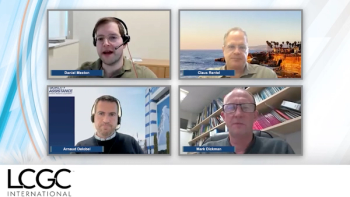
The panel dives into the regulatory stance on oligonucleotide enantiomers. The role of batch-to-batch reproducibility, new drug application (NDA) filing, and current guidelines are covered.

This episode covers strategies in place for the analysis of impure mixtures with a larger range of retention factors while still maintaining separation power.

There is a broad range of chemistries available for the analysis of oligonucleotides, and the panel narrows in on stationary phases and column materials relevant to ASOs.

The main focus of this Peer Exchange is on the state of the art for antisense oligonucleotides (ASOs) in particular. The panel shares their perspectives on the most pressing analytical challenges the industry currently faces regarding these oligonucleotides.

The panel introduces themselves and provides some background on their experience with oligonucleotide analysis.

LCGC North America
Click the title above to open the LCGC North America August 2020 issue, Volume 38, Number 8, in an interactive PDF format.

LCGC North America
Click the title above to open the LCGC North America April 2020 issue, Volume 38, Number 4, in an interactive PDF format.
Special Issues
Click the title above to open the Current Trends In Mass Spectrometry October 2019 special issue in an interactive PDF format.

LCGC North America
An essential tool for troubleshooting and tuning GC–MS instruments is the tune report; this article explains the meaning and uses of this report when combined with a tuning compound.
LCGC North America
Glycosylation is the most common monoclonal antibody (mAb) posttranslational modification. What is essential to know about it?
LCGC North America
Click the title above to open the LCGC North America August 2019 issue, Volume 37, Number 8, in an interactive PDF format.
Special Issues
Click the title above to open the August 2019 issue of the LCGC North America Annual Industry Trends & Directory Issue, Volume 37, Number 8, in an interactive PDF format.
Special Issues
Special Issues
Special Issues
Special Issues
Special Issues
Special Issues
Special Issues
LCGC North America
In LC–MS, the importance of tuning and calibrating the mass spectrometer cannot be overemphasized. There are six main aspects to address.
Special Issues
Special Issues
Special Issues
Special Issues
Special Issues

September 30th 2024
September 30th 2024

September 30th 2024

August 1st 2020

September 30th 2024
September 30th 2024