LCGC Asia Pacific
How do non-alkylsilica columns provide us an additional dimension of column selectivity?
LCGC Asia Pacific
How do non-alkylsilica columns provide us an additional dimension of column selectivity?

LCGC Europe
How do non-alkylsilica columns provide us an additional dimension of column selectivity?

LCGC North America
When developing or modifying an LC separation, a common strategy is to change selectivity by choosing a new column. Here’s guidance for making that selection.

LCGC North America
Reversed-phase liquid chromatographic columns can be compared quantitatively for differences in selectivity by means of the hydrophobic-subtraction model. This allows selection of columns that are either equivalent or different in selectivity. The present paper both presents a summary of this approach and shows in detail how to use it in practice.

LCGC Europe
A pioneer in high performance liquid chromatography reflects on his career and how "enlightened trial-and-error" can reduce the effort involved in method development.

LCGC North America
A pioneer in high performance liquid chromatography reflects on his career and how "enlightened trial-and-error" can reduce the effort involved in method development.

LCGC Asia Pacific
We focus on the characterization of reversed-phase columns with particular emphasis on the hydrophobic-subtraction model

LCGC North America
The coauthors discuss the various attributes of and approaches to reversed-phase chromatography.
LCGC Europe
We focus on the characterization of reversed-phase columns with particular emphasis on the hydrophobic-subtraction model
LCGC Europe
In the last part of this series, the authors provide a technical review of the means for method adjustment and the pertinent regulations concerning the required validation of adjusted methods.
LCGC Europe
In the first part of this series, the authors look at method modification from a scientific and regulatory standpoint with regard to changing a column and the operating parameters.
LCGC North America
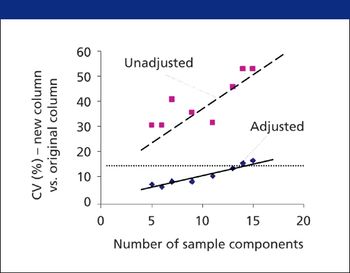
When a column is replaced with a new or "equivalent" column, sometimes the chromatogram can change so much that it is no longer suitable for its intended use. In such cases, method adjustment is necessary to correct the change. How much can the chromatographic variables be changed before revalidation is required? What do the regulatory agencies have to say about method adjustment? The authors discuss these issues and propose a technique that can be used to speed selection of new operating conditions.
LCGC North America
Guest authors Lloyd Snyder and John Dolan describe a method for determining reversed-phase column selectivity.
August 1st 2012

June 1st 2010