

LCGC North America
"As research advances, about half of what we will teach you . . . will turn out to be wrong. The problem is, we presently don't know which half." Powerful Medicines, Jerry Avorn, 2004

Michael P. Balogh is the former editor of "MS - The Practical Art," he wrote his last column in September 2011. He is currently Principal Scientist, LC-MS Technology Development, with Waters Corp., Milford, Massachusetts, and is a member of LCGC's editorial advisory board. Kate Yu has taken over the column. For current articles on the field of mass spectrometry and the various hyphenated techniques, including LCâMS, GCâMS, and tandem MS, please visit: http://www.chromatographyonline.com/Column%3A+MS+-+The+Practical+Art
LCGC North America
"As research advances, about half of what we will teach you . . . will turn out to be wrong. The problem is, we presently don't know which half." Powerful Medicines, Jerry Avorn, 2004

LCGC North America
This month's column brings much of the previous discussion on how to interpret mass spectra to a practical examination of detecting substitutions in counterfeit pharmaceuticals.
LCGC North America
In this month's "MS-The Practical Art," Michael Balogh takes a closer look at insight provided by Chuck McEwen regarding obstacles while using solvents.
LCGC North America
This month's installment of "MS - The Practical Art" reprises a talk from Chris Lipinski that examines the analytical road ahead in drug discovery and the quest to expand the chemistry landscape and its inherent analytical demands.

LCGC Europe
Although interpreting MS spectra can be a thorny problem at least some of the time, in the words of Fred McLafferty, "All you are dealing with is the mass of the molecule and the masses of the pieces."
LCGC North America
Over the last ten years or so, information gathered by applying atmospheric ionization techniques in mass spectrometry teaches us two things: 1) that liquid is a vestigial remnant of condensed-phase liquid chromatography and 2) that solvent in the gas phase limits ionization to molecules that are more basic than the solvent.
LCGC North America
October 2006. This month's "MS - The Practical Art" will interest those starting a new good laboratory practices (GLP) bioanalytical laboratory, reassessing an existing lab, or revamping a "spirit-of-GLP" laboratory to full GLP status.

LCGC Europe
Producers of mass spectrometers design their instruments to work well within specific parameters.

LCGC North America
In Part I of this two-part look at spectral interpretation, Michael Balogh examined the ability to see and appreciate the product of our analytical devices. In Part II, he takes a closer look at the tools of the trade.

LCGC Europe
Liquid chromatography–mass spectrometry (LC–MS) has been increasingly indispensable in most analytical pursuits. Such acceptance would not have occurred without encouraging, early academic efforts and also the efforts of early practitioners who pressed manufacturers to improve and extend electrospray's capabilities. I briefly described the commercialization of LC in its halcyon period of the early 1990s in a 1998 article.¹
LCGC North America
In this column, Michael Balogh proposes some practices that you can adopt to enhance your prospects of being right when converting data to knowable information and applying it to solving problems.
LCGC Europe
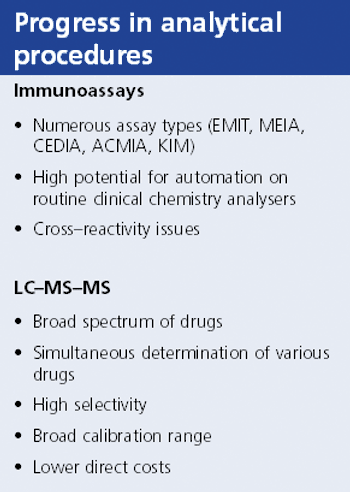
An increasingly available and attractive clinical analysis method, LC?MS nevertheless fails to directly benefit from the knowledge and experience of clinicians steeped in the immunoassay tradition.

LCGC North America
This month's column explores the idea that despite the well-considered physics and engineering involved in mass spectrometer technology, it nonetheless seems that the uality of one's results are as much the product of art as they are of science.

LCGC North America
Definitions, however meticulously crafted, can give the meaning of terms with scrupulous clarity, but often fail to tell us how to apply them. Such definitions are descriptions that dictate usage but stop well short of the sense and purpose that many of us turn to them for.
LCGC North America
For great advancements in understanding made by intuitive leaps to be successful, they must withstand rational scrutiny.

LCGC Europe
The effects of increased data demand coupled with the torrential data outflow of our instruments can overwhelm even the most IT-savvy.

LCGC Europe
The Centers for Disease Control and Prevention (CDC) estimates that each year in the United States, 76 million people get sick, 325000 are hospitalized and 5000 die from food-related illnesses. Food-borne illness is a serious public health problem. -National Library for the Environment, Food Safety Issues in the 107th Congress, 2001, Donna U. Vogt.
LCGC North America
Few areas of LC-MS practice have been so affected by geopolitics as that of food safety analysis, a topic as important as it is complex. here, Michael Balogh examines this topic.

LCGC Europe
Where the wizard stands behind the curtain working levers.
LCGC North America
The applications of mass spectroscopy to clinical chemistry are discussed with the help of this month's featured scientists.
LCGC Europe
In this initial instalment, several MS technologies and strategies currently being applied to characterize drug candidates in early stage development are presented.
LCGC North America
Columnist Michael Balogh explores the topics of informatics and data management with this month's featured scientists.
LCGC North America
process is interesting and involved, and in this month's installment of "MS - The Practical Art," Michael Balogh continues the Profiles in Practice series by exploring this topic with featured scientists Michele Kelly and Mark Kershaw.
LCGC Europe
This month’s column provides an overview of several recently developed technologies that aim to improve the utility and performance of mass spectrometers in a number of applications.

LCGC North America
In this initial installment of "MS - The Practical Art," a new series of columns is introduced that investigates various aspects of mass spectrometry (MS) from the perspective of some leading practitioners. Here, featured scientists Kathleen Cox and Timothy Baker discuss several MS technologies and strategies currently being applied to characterize drug candidates in early stage development.
LCGC Europe
The authors discuss the issue of meeting the demands of regulatory compliance whilst ensuring good scientific practice. A number of requirements from 21 CFR Part 11 are cited to demonstrate the importance of applying the principles of risk analysis.
LCGC North America
Several recently developed technologies are described, along with the ways they can improve the utility and performance of mass spectrometers.
LCGC Europe
The authors look at how achieving both greater throughput and increasing informational content is a driving force in small-molecule analysis. They describe how analysts should address mechanical increases in productivity, software implementation flow and data management, and effective sample preparation to improve efficiency and reduce frustration.
LCGC Europe
In the second instalment of this newly introduced column, Michael Balogh looks at resolution and mass accuracy as important considerations for determining the suitability of a mass spectrometer for an intended purpose.
LCGC Europe
In the first of this new column, Michael Balogh takes a look at source design and the strengths of multimode ionization, such as its ability to switch at high speeds between electrospray and atmospheric-pressure chemical ionization.