Articles by Diane M. Diehl

Mass spectrometry (MS) is emerging as a critical tool in biopharmaceutical late stage development, manufacturing, and quality control (QC) environments. The rapid growth of biologics in development, the increasing demand for more robust analytical technologies to directly monitor the critical quality attributes (CQAs) of these new drugs, and longer term industry initiatives aimed at improving quality and productivity, such as quality by design (QbD) regulatory submissions and continuous manufacturing, are all fueling a greater need for mass monitoring with MS.

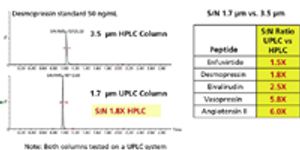
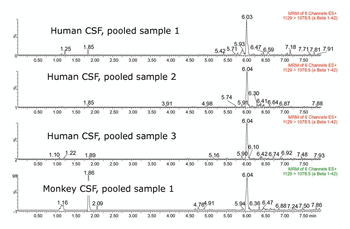
Fast, flexible platforms for peptide quantification are needed, particularly for a discovery setting. This type of methodology would be especially advantageous in the case of amyloid beta (a?) peptides.

The growing market for biotherapeutic peptides and the development of quantitative methods for those analytes has brought to light the challenges facing the analysis of this broad range of compounds. Market forces and regulatory requirements are encouraging analytical groups to develop methodologies that are time- and cost-effective, while still producing assays that are sensitive enough to cope with biological matrices.

Streamlined sample prep, LC and MS method development.
Streamlined sample prep, LC and MS method development.
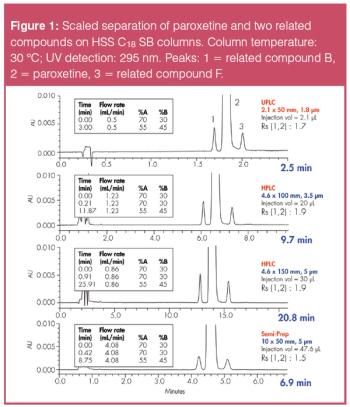
As UPLC users convert or replace their existing HPLC systems with UPLC systems there is a transition period where a method must be run on both platforms. Thus, having the same particle substrate and bonded phases available in HPLC and UPLC particle sizes can significantly ease the burden of method development and transfer from one platform to another. In addition to the ethylene bridged hybrid (BEH) particle, three new high strength silica (HSS) stationary phases for HPLC applications are introduced. Scalability between both column diameter and particle size is demonstrated on both UPLC and HPLC instrumentation.

Zhe Yin, Kenneth J. Fountain, Erin E. Chambers and Diane M. Diehl, Waters Corporation, Milford, Massachusetts, USA.

Morphine is an effective pain-relieving drug that is primarily metabolized into morphine-3-glucuronide (M3G) and morphine-6-glucuronide (M6G). The highly potent M6G may have adverse effects, such as respiratory depression and renal failure, if accumulated in the body. As morphine abuse continues to affect modern society, an effective method must be established to analyse morphine and its structurally related compounds in biological fluid samples. In this work, a UPLC–MS-MS method was developed to separate six morphine-related compounds on a 2.1 Ã- 100 mm, 1.8 μm ACQUITY UPLC HSS T3 column in a single run using an ACQUITY UPLC system connected to a fast-scanning triple-quadrupole MS detector (TQD). The method achieved adequate retention of these very polar compounds by reversed-phase (RP) chromatography in an 8-min total run time.

Using HILIC with highly efficient ethylene bridged hybrid (BEH) particles results in faster methods that exhibit improved polar retention, higher sensitivity, enhanced chromatographic resolution and significantly improved column lifetime.
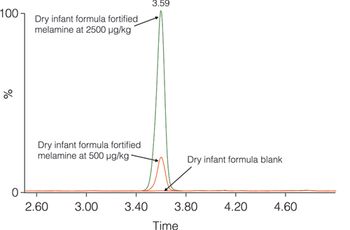
This method is rapid and sensitive for the analysis of melamine and cyanuric acid simultaneously in infant formula. Using two Oasis solid-phase extraction protocols and the ACQUITY UPLC, the results are consistent with the published US FDA interim method, while demonstrating a reduced analysis time.
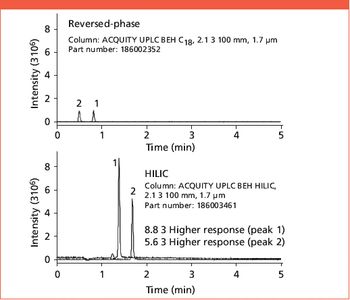
Using HILIC with highly efficient ethylene bridged hybrid (BEH) particles results in faster methods that exhibit improved polar retention, higher sensitivity, enhanced chromatographic resolution, and significantly improved column lifetime.

A highly sensitive analytical method for the analysis of tamsulosin in human plasma has been developed for use in bioanalytical studies. The solid-phase extraction (SPE) and UPLC–MS–MS methodologies are described, as well as performance against validation parameters.

Several common birth control formulations contain both drospirenone and ethinyl estradiol. A highly selective and sensitive analytical method for the analysis of drospirenone in human plasma has been developed for use in bioequivalence studies. The solid-phase extraction (SPE) and UPLC–MS–MS methodologies are described as well as performance against validation parameters.

Several common birth control formulations contain both drospirenone and ethinyl estradiol. A highly selective and sensitive analytical method for the analysis of drospirenone in human plasma has been developed for use in bioequivalence studies. The solid-phase extraction (SPE) and UPLC®–MS–MS methodologies are described as well as performance against validation parameters.


Using ACQUITY UPLC technology with triple quadrupole MS detection enhances the selectivity, sensitivity and throughput in quantitative bioanalytical studies. Detection limits for these methods are being driven lower and lower as drugs become more potent.

An ultrahigh-pressure liquid chromatography (UHPLC) method was developed to separate paroxetine from several of its related compounds using a systematic screening protocol that monitors combinations of selectivity factors including column chemistry, organic modifier, and pH. When the best combination of these factors was selected, the method was optimized by varying gradient slope and temperature.

The use of 30 mm UPLC columns coupled with Oasis SPE in µElution format was investigated to increase the speed of quantitative bioanalytical methods while maintaining sensitivity and resolution of closely related analytes.

The effect of switching between high and low pH mobile phases on a single analytical HPLC column was investigated. The ability to rapidly switch between pH extremes on XBridge columns without special washing/re-equilibration steps dramatically reduces the time for separation of pharmaceutical compounds.

UltraPerformance LC (UPLC) has been widely accepted by chromatographers because of improvements over HPLC in the sensitivity, resolution and speed of separations. As scientists begin to use this technology for impurity and metabolite profiling, they will need to transfer the methods to preparative LC to isolate and purify their compounds for further research. Therefore, it is necessary to systematically transfer UPLC assays not only to HPLC, but, more importantly, to preparative chromatography. In this application, we provide information on how to scale a UPLC impurity/degradant separation to a preparative LC separation.

Eric S. Grumbach, Diane M. Diehl and Jeffrey R. Mazzeo, Waters Corporation
The authors look at how achieving both greater throughput and increasing informational content is a driving force in small-molecule analysis. They describe how analysts should address mechanical increases in productivity, software implementation flow and data management, and effective sample preparation to improve efficiency and reduce frustration.