
The Application Notebook
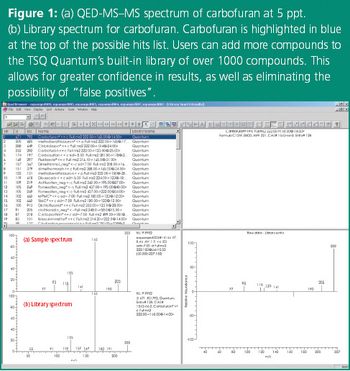
This application note describes an LC–MS–MS method for on-line sample preparation and concentration of drinking water samples prior to analysis using a triple quadrupole with full scan Q3 confirmation.
The Application Notebook
This application note describes an LC–MS–MS method for on-line sample preparation and concentration of drinking water samples prior to analysis using a triple quadrupole with full scan Q3 confirmation.

The Application Notebook
One problem frequently encountered in LC–MS is the appearance of mass peaks, which appear totally unrelated to the samples run - "ghost" mass peaks. It is impossible to differentiate whether these signals come from an unknown component in the sample co-eluting with a known peak, or from an impurity in the mobile phase or from some residual contamination "bleeding" from the column.

The Application Notebook
A Deans switch, employing Agilent's Capillary Flow Technology, was configured on an Agilent 7890A GC equipped with dual ECD detectors. A method was developed for the analysis of fish oil for PCB contamination. The Deans switch was used to heart cut 7 indicator PCBs (IUPAC Numbers 28, 52, 101, 118, 138, 153 and 180) from the primary DB-XLB column on to a DB-200 column for further separation. Fish oil from a supplement capsule was simply diluted 1:10 in isooctane and injected directly. To prevent carryover, contamination and retention time shifts, the Deans switch was used to backflush the primary column at the end of each run.

The Application Notebook
Preliminary studies of biodiesel samples by a high speed LC–MS system using electrospray ionization and a patented cone-wash feature demonstrate that LC–MS reduces the analysis time to 20 minutes and reveals information about higher molecular weight compounds in biodiesel while still detecting many low molecular weight chemicals, including FAMEs, at high sensitivity.

The Application Notebook

The Application Notebook
The use of 30 mm UPLC columns coupled with Oasis SPE in µElution format was investigated to increase the speed of quantitative bioanalytical methods while maintaining sensitivity and resolution of closely related analytes.

The Application Notebook
AC Analytical Controls developed a new chromatographic solution that complies with all ASTM & EN chromatographic test methods listed in biodiesel specifications: the AC all-in-one Biodiesel analyser. Analysis results demonstrate that the AC analyser complies with EN 14103, EN 14105, EN 14106, EN 14110 & ASTM D6584 methods.