

The Column
Waters and Restek have entered into a co-marketing agreement aimed at food safety laboratories and promoting the use of Waters gas chromatography–mass spectrometry instruments with Restek GC consumables.
The Column
Waters and Restek have entered into a co-marketing agreement aimed at food safety laboratories and promoting the use of Waters gas chromatography–mass spectrometry instruments with Restek GC consumables.

The Column
Toxicological surveillance of illicit prescription and illegal drug abuse has been carried out using post-mortem data from Clark Country, Nevada, USA, with GC–MS, headspace GC–MS, GC×GC–MS, LC–MS, and ELISA.

The Column
Analysis of red lacquerwares from the Japanese Jõmon Period (approximately 14,000 to 500 BC) by Py-GC–MS has revealed the materials and fabrication techniques used in their production.

The Column
The drive behind multipath liquid chromatography (LC), a new concept developed by Kevin Schug and his group, is presented.
The Column
Shimadzu has been awarded the 2018 NRW.Invest Award by the North Rhine‑Westphalia (NRW) region of Germany.


The Column
This proof-of-principle study shows that polymer-based sorptive extraction probes, coupled with secondary focusing by thermal desorption and analysis by flow-modulated GC×GC–TOF-MS/FID, can be used to separate and identify flavour compounds in milk. As well as comparing the profiles of dairy and non-dairy milks, this article highlights the practical benefits of this sampling procedure, the ability of two-dimensional GC to physically separate components that would coelute in one-dimensional GC, and the use of software tools to improve workflow.

The Column
When a company wishes to commercialize a new pesticide, they must conduct environmental studies and develop analytical methods capable of detecting the pesticide, and its metabolites, in soil and water samples. The methods must be robust and rugged, for easy use in routine analysis. James Stry, a principal investigator at FMC Agricultural Solutions, recently talked to LCGC about best practices he and his team have established for developing such methods, including approaches to meeting a variety of requirements of regulatory bodies, simplifying sample preparation, dealing with matrix effects, choosing an ionization method, and streamlining method development.
The Column
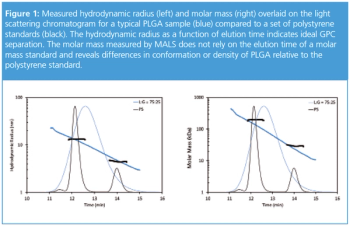
The functional properties of polymers, such as poly(lactic-co-glycolic acid) (PLGA), relevant to drug delivery and biomedical devices, are governed by the molecular properties of molar mass, composition, conformation, and branching. This article demonstrates how such polymers are fully characterized, quickly and absolutely, using gel permeation chromatography (GPC) with multi-angle light scattering (MALS) and online viscometry.

The Column
Approximately 40% of recombinant proteins that are purified use a histidine tag for easy capture. This article covers how to automate the purification of histidine-tagged proteins and how purification conditions can be optimized to an automated four-step purification scheme that uses affinity-, ion exchange-, and size-exclusion columns. Using a multistep purification scheme removes the manual steps that cause loss of precious proteins and take more time, like dialysis, collection, and reinjecting samples. The final purification scheme reduces a 3–4-day process to 11.5 h from start to finish, all while improving reproducibility, yield, and comparable purity.
The Column
Click the title above to open The Column September 2018 North American issue, Volume 14, Number 9, in an interactive PDF format.
The Column
Click the title above to open The Column September 2018 Europe & Asia issue, Volume 14, Number 9, in an interactive PDF format.