

LCGC Europe
Click the title above to open the LCGC Europe July 2019 regular issue, Volume 32, Number 7, in an interactive PDF format.
LCGC Europe
Click the title above to open the LCGC Europe July 2019 regular issue, Volume 32, Number 7, in an interactive PDF format.

LCGC Europe
The main objective of this review article is to provide a clear summary of the different methods that can be used to quantify endogenous small molecules. Because of the increased use of mass spectrometry (MS) in the field of bioanalysis, a special focus will be placed on quantification by liquid chromatography (LC)–MS. Practical recommendations to face this bioanalytical challenge, in particular in terms of method validation, will also be provided.

LCGC Europe
For liquid chromatography (LC) methods where the buffer pH and composition have an influence on retention, which buffer preparation method will provide the most repeatable results?

LCGC Europe
This instalment of “GC Connections” dives into temperature programming. First, the differences in peak widths and retention times between temperature programmed and isothermal chromatograms are examined. Why are all the peaks so sharp in temperature programmed GC, yet they get broader (and shorter) in isothermal GC? Next, we explore some early ideas about temperature programming and peak broadening that explain why the peaks are so sharp in temperature-programmed GC, and why the peak spacing is different from isothermal GC. Finally, we examine an important consequence of our ability to program temperature: the need for temperature programming in splitless and other injections that use “solvent effects” and other peak focusing mechanisms. These points are illustrated using several historical figures and chromatograms from the early days of GC.
LCGC Europe
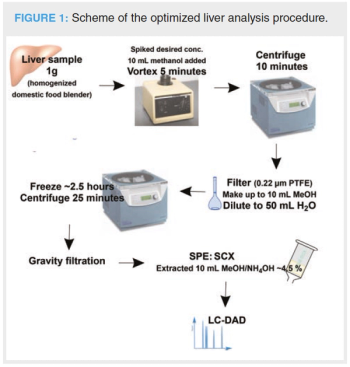
Currently, sample treatment is still the bottleneck in the development of analytical methods to analyze complex samples, especially for routine analysis where high-tech instruments are not always available. Research on the evaluation of different sample treatments is needed to achieve the sensitivity and selectivity required. This article presents a case study related to the determination of sulphonamides in liver. Different extraction strategies, including solid-liquid extraction (SLE), ultrasound-assisted extraction (UAE), and solid-phase extraction (SPE), were evaluated to produce a simple and effective extraction method.

LCGC Europe
The international, interdisciplinary workshop Solutions and Workflows in (Environmental) Molecular Screening and Analysis (SWEMSA 2019) will be held 21–23 October 2019 in the City Hall in Erding, Germany.