January 2024

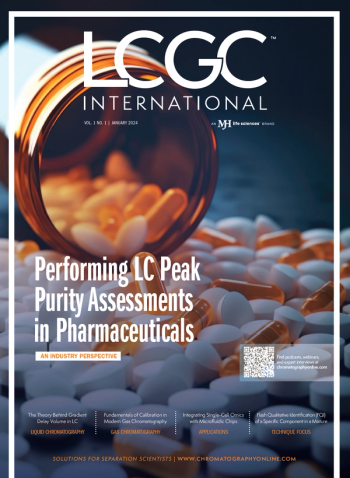
Performing chromatographic peak purity assessments (PPA) in the pharmaceutical industry | Image Credit: © Vladimir Polikarpov - stock.adobe.com

This review article discusses scientific rationales and current best practices in the pharmaceutical industry for performing chromatographic peak purity assessments (PPA). These activities are associated with the development and validation of liquid chromatographic (LC) stability-indicating analytical methods applicable to regulatory submissions of small-molecule drug candidates. The discussion includes a comprehensive overview of the PPA-related regulatory and scientific landscape and common industry approaches to obtain PPA results, as well as the strengths and weaknesses of PDA-facilitated ultraviolet (UV) PPA and other PPA techniques.


Tubes | Image Credit: © Sirer - stock.adobe.com

The gradient delay volume is arguably one of the most important, yet least appreciated, parameters that affect how gradient elution separations in LC work. This has implications both for method development and for method transfer during the lifecycle of a LC method. In this installment, I will review the concept of gradient delay volume, its physical connection to the LC instrument, and how it can impact method development and separation quality.

Nicholas H. Snow

Gas chromatography is a premier technique for quantitative analysis. As gas chromatographs have become simpler to use and data systems more powerful, much of the data processing involved in delivering quantitative results now happens in the background and is seemingly invisible to the user. In this installment, we will review the calibration techniques used with gas chromatography. We will compare calibration methods and the assumptions that underlie them. We will explore common mistakes and challenges in developing quantitative methods and conclude with recommendations for appropriate calibration methods for quantitative problems.

Various pharmaceuticals | Image Credit: © Kaesler Media - stock.adobe.com

Biopharmaceutical analysis is a rapidly evolving field that requires the development of new technologies and methods to keep pace with the increasing complexity of biologics. One of the most promising areas of research is the use of single-cell omics and microfluidic chips for the analysis of biopharmaceuticals. Single-cell omics has revolutionized our understanding of cellular heterogeneity, while microfluidic chips have enabled high-throughput analysis of single cells that provide an understanding of the complex biological network that complements the genomics and transcriptomics studies. This article will explore some of the emerging trends and technologies in biopharmaceutical analysis, with a particular focus on single-cell omics and microfluidic chips. We will also discuss the developments in ambient ionization mass spectrometry such as sub nanoampere ionization and the potential of low current ionization in studying cell-to-cell heterogeneity and its role in metabolomics.

Ultra high performance chromatography (HPLC) setup for separation and analytical chemistry. | Image Credit: © Artur Wnorowski - stock.adobe.com

This paper proposes a new method of flash qualitative identification (FQI) to qualitatively identify a certain target component from a mixture within half a second by disusing the analytical column, which is a time-consuming unit in current chromatography instruments. First, a Noised Spectrum Identification (NSI) model was constructed for the data set generated directly by diode array detector (DAD) without the process in an analytical column. Then, a method called vector error algorithm (VEA) was proposed to generate an error according to the DAD data set for a mixture and a specific spectrum for the target component to be identified. A criterion based on the error generated by the VEA is used to give a judgement of whether the specific spectrum exists in the DAD data set. Several simulations demonstrate the high performance of the FQI method, and an experiment for three known materials was carried out to validate the effectiveness of this method. The results show that the NSI model concurs with the real experiment result; therefore, the error generated by the VEA was an effective criterion to identify a specific component qualitatively, and the FQI method could finish the identification task within half a second.