Tips & Tricks: GPC/SEC
Tips & Tricks: GPC/SEC

LCGC Europe
LCGC Europe has revamped its digital media portfolio to complement the peer-reviewed magazine.

LCGC Europe
Planar chromatography e-book; Web-based dashboard; On-demand webinars; Streamline syringe selection; Chromatography software update


LCGC North America
There is an old saying regarding the world of fashion that says if you wait long enough, everything comes back into style eventually. While this saying may have provided the necessary excuse for many people (myself included) to avoid throwing away favorite old articles of clothing, the underlying truth that everything is cyclical cannot be denied, and this certainly holds just as true for the field of chromatography as it does for any other field.
The Application Notebook
In a market as dynamic and fast-paced as ours, it should come as no surprise that in the months since I last addressed our readers in this space, a great deal has taken place in the world at large and in the field of separation science in particular.
E-Separation Solutions
The introduction of the new Kinetex™ core-shell technology provides a significant benefit to all separation scientists looking to increase sample throughput by reducing chromatographic analysis times while maintaining chromatographic resolution.
The Application Notebook
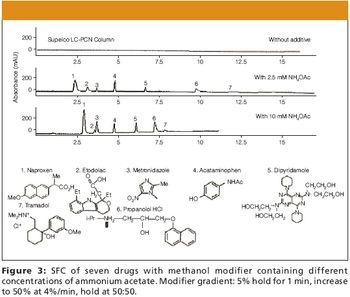
Supercritical fluid chromatography (SFC) has been practiced for approximately 50 years. SFC on packed columns for both qualitative and quantitative purposes underwent a renaissance in interest at the beginning of the 1990s when limitations of capillary SFC became obvious and important progress in composition gradient techniques for mixed mobile phases was achieved. Even with these instrumental improvements, wide acceptance of the technology was not forthcoming because the perception was that highly polar analytes were not soluble in carbon dioxide and thus were not separable. It is now apparent that the use of additives dramatically extends the range of solute polarity amenable to SFC.
The Application Notebook
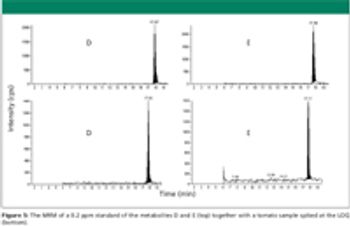
The high-throughput analysis of pesticides in raw agricultural commodities has been hindered by the slow and laborious sample preparation stages. Using traditional clean-up procedures, as many as 20 steps are required to get the sample in a convenient form for analysis, which typically limits sample throughput to eight samples per day. This study evaluates a new approach using a novel laboratory mill and pulverizer to extract various pesticide residues from different kinds of plant materials and to identify and quantitate the active ingredients by liquid chromatography–tandem mass spectrometry (LC–MS-MS). It shows that by automating the procedure, the number of clean-up steps can be reduced significantly, which increases sample throughput over traditional approaches.
E-Separation Solutions
The answer to the following reader question about protein separations was supplied by LCGC's "Directions in Discovery" columnist Tim Wehr.
E-Separation Solutions
Varian, Inc. has published an application note entitled Determination of Aminoglycoside Antibiotics by HPLC with ELSD. Streptomycin and neomycin are members of the family of antibiotics called aminoglycosides.
Oligosaccharides Analysis Using U-HPLC with RI Detection -Hitachi Apps Note
Enhancement of UV Detection Sensitivity in SFC Using Reference Wavelength Compensation - Thar Apps Note
LCGC Europe eNews
The 4th International Symposium on Recent Advances in Food Analysis (RAFA 2009) will be taking place in Prague, Czech Republic, between 4–6 November 2009.
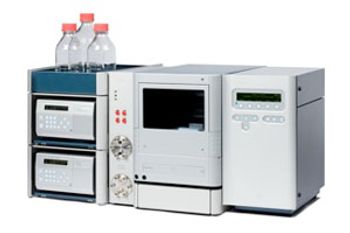
This week, Antec will introduce its newly developed ROXY Electrochemistry/LC system for up-front MS at the 18th IMSC Bremen, Germany, Aug 30 – Sep 04. Take the opportunity and visit us at booth nr. C25
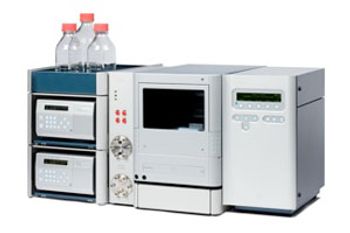
Antec (Leyden) is a worldwide supplier of Analyzers based on HPLC with electrochemical detection. With the newly introduced ROXY? System, on-line Electrochemistry/LC/MS for metabolic profiling of drug compounds, oxidative damage of Proteins, DNA, etc., becomes possible for the first time.
Generate well-resolved, reproducible data for tea seed oil authentication, triglyceride identification, and seed oil oxidation evaluation with Waters® ACQUITY UPLC®/PDA/SQD System.
LCGC Europe eNews
Swiss bioscience company INTEGRA Biosciences and American liquid handling company Viaflo have signed agreements that will see the two companies combine.

More on melamine extraction in dairy and biological samples.
Thermo Fisher Scientific (Franklin, Massachusetts) announced that its Radiation Measurement and Security Instruments (RMSI) business has completed its 12th annual radiation monitoring techniques training course outside of Kiev, Ukraine, and within the vicinity of the Chernobyl nuclear power plant.
LCGC Europe eNews
Beckman Coulter has announced that it will be combining Agencourt Bioscience and the newly acquired Cogenics to Beckman Coulter Genomics.
Applied Biosystems will assist the Chinese government in reinforcing new standards for food safety.
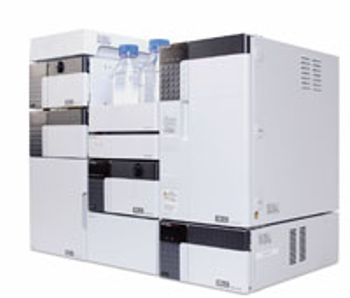
Toxicological analysis of body fluids is an important task whenever acute intoxications, abuse of drugs or consumption of illicit drugs needs to be identified. Such analyses require a universal sample pretreatment and identification method and should be automated for speed and simplicity.
The Column
Improving Chromatographic Performance by Using Freshly Delivered Ultrapure Water in the Mobile Phase Maricar Tarun, Coralie Monferran, Cecilia Deveaux and Stephane Mabic A More Efficient Extraction of Melamine from Various Matrices using Resin-based Mixed-mode Cation Exchange SPE and Analysis with LC-MS-MS Lee Williams, Joanna Caulfield and Elena Gairloch News Awards for waste reduction and capillary chromatography, carotenoids for eye care and the buyout of Varian by Agilent are the stories in this issue. Market Trends and Analysis Market Profile: GC-MS Glenn Cudiamat Tips & Tricks: GPC/SEC Temperature Effects in GPC/SEC Thorsten Hofe and Daniela Held Events
Pittcon (Pittsburgh, Pennsylvania) announced that Alan G. Marshall, Kasha Professor of Chemistry and Biochemistry at Florida State University (Tallahassee, Florida) and director of the Ion Cyclotron Resonance Program at the National High Magnetic Field Laboratory will be the plenary lecturer during the opening session on March 1 at Pittcon 2010.