

High Temperature Pharmaceutical Analysis using Sub-2µm ZirChrom-PBD - Zirchrom Apps Note
High Temperature Pharmaceutical Analysis using Sub-2µm ZirChrom-PBD - Zirchrom Apps Note
Thermo Fisher Scientific (San Jose, California) announced that it will be hosting a series of seminars that demonstrate the company?s expertise in food safety.
LCGC Europe eNews
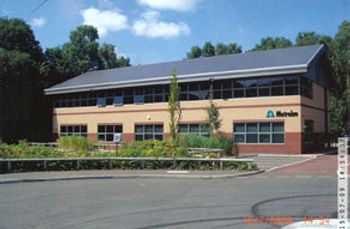
Metrohm UK has announced that on 14 September it will be moving its UK headquarters to new purpose built facilities in Runcorn, Cheshire, UK.
LCGC Europe eNews
Agilent Technologies has announced that it will be expanding its commitment to open systems for chromatography data systems through collaboration with Persistent Systems.
According to a report in the Daily Progress, a Charlottesville, Virginia newspaper, Biotage Inc. will be moving its U.S. headquarters from its University of Virginia Research Park facility in Charlottesville to a 15,000-square-foot facility near Charlotte, North Carolina.
PerkinElmer, Inc. (Shelton, Connecticut) has signed an expanded distribution agreement with VWR International, LLC (West Chester, Pennsylvania), a global laboratory supply and distribution company.
The Column
Pervasive PFCs: An SPE-LC–MS Method for Their Determination in Water and Wastewater Norbert Helle, Meike Baden and Kaj Petersen High-temperature Gradient Adsorption Liquid Chromatography - A Novel Way of Separation for Polyolefins T. Macko, R. Brüll, Y. Wang and Y. Thomann Fuel for Thought A summary of the latest developments on petroleum analysis and the search for alternative fuels News Incognito Are You Optimizing Your Solid-Phase Extraction? Q&A John Lough from the University of Sunderland talks about his tenure as president of The Chromatographic Society Events
The introduction of the new Kinetex core-shell technology provides a significant benefit to all separation scientists looking to increase sample throughput by reducing chromatographic analysis times while maintaining chromatographic resolution. This is especially important for QC labs, which typically have limited resources and can benefit the most from faster separations and higher sample throughput, allowing them to make the best use of their limited resources. However, the benefits derived from faster separations are equally important to discovery and method development departments as well.
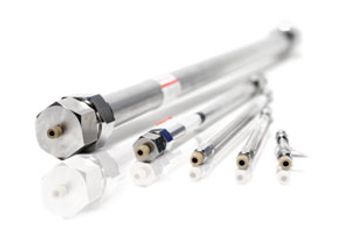
Tosoh Bioscience offers media and prepacked columns for all common modes of liquid chromatography; from TSK-GEL HPLC columns to TOYOPEARL resins for Biopurification and the semi-micro GPC instrument EcoSEC.
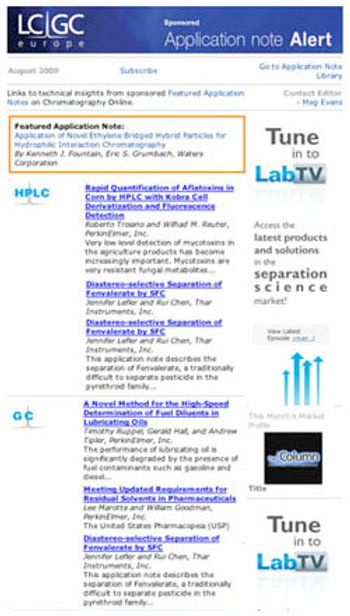
LC?GC Europe is pleased to announce that following the success of the North American E-Application Note Alert, it will be producing a European E-Application Note Alert.

E-Separation Solutions
With an IC instrumentation market forecast to grow more than 7% by 2012, ion chromatography is a thriving segment of the separation science industry. And with application in the areas of environmental, pharmaceutical, and agricultural research, this technique will find continued utility for years to come.
A new facility for Grace Davison Discovery Sciences has opened in Rowville, Australia.
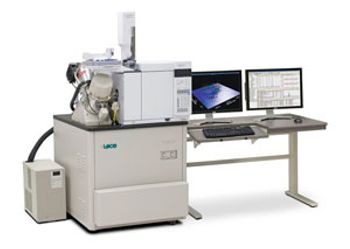
LECO?s patented ChromaTOF software provides a one-stop software package for a fully automated instrument solution from sample introduction, data acquisition, True Signal Deconvolution (TSD) to analyte quantification and report generation.
Monoclonal Antibody Heterogeneity by Cation-Exchange Chromatography - Dionex Apps Notes
Agilent Technologies, Inc. (Santa Clara, California) announced its collaboration with software product development company Persistent Systems (San Jose, California) to promote multivendor chromatography system interoperability.
Eluent Consumption by Optimizing UltiMate 3000 Quaternary Analytical Systems for Small Column Volumes - Dionix Apps Note
Organic Acid Analysis: Simple, Easy & Reliable - Microsolv Apps Note
LCGC Europe eNews
SGE Analytical Science has appointed Ian Ransley, PhD, as director of the mass spectrometry business unit.
MALS for Proteins - Wyatt Apps Note
E-Separation Solutions
There is an old saying regarding the world of fashion that says if you wait long enough, everything comes back into style eventually.


LCGC Asia Pacific
Knauer Application Note

LCGC Asia Pacific
PerkinElmer Application Note
LCGC Asia Pacific
Waters Application Note

LCGC Europe
Describing the theoretical background on how the separations occur, the operating approaches that can be taken and method development.

LCGC Europe
Euroanalysis 2009, which is organized under the umbrella of the Division of Analytical Chemistry (DAC) of the European Association for Chemical and Molecular Sciences (EuCheMS), has become a premier event for scientists to discuss and hear presentations on a broad spectrum of analytical techniques from a diverse range of applications. Euroanalysis aims to bring together analytical chemists from various fields to stimulate communication and strengthen networks in analytical sciences.

LCGC Europe
When is curve weighting a good idea?
Chiral Technologies, Inc. (West Chester, Pennsylvania), a global provider of chiral chromatography columns, has signed a distribution agreement with Canadian Life Science (Peterborough, Ontario) to better serve its customers throughout Canada.

LCGC North America
A multilaboratory collaborative study organized by the Human Proteome Organization demonstrated that participating laboratories had difficulty in identifying components of a simple protein mixture.