

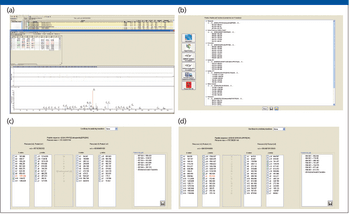
Clandestine PDE-5 Inhibitor in a Dietary Supplement - Varian App Note
Clandestine PDE-5 Inhibitor in a Dietary Supplement - Varian App Note
ATP from AMP, Reproducible Polar Nucleotide Separations - Microsolv - Apps Note

E-Separation Solutions
The answer to the following reader question about stability indicating methods was supplied by LCGC’s “ Validation Viewpoint ” columnist Michael Swartz.

E-Separation Solutions
Joining us for this discussion are Terry Berger of Aurora SFC Systems, Inc.; Todd Palcic of TharSFC, a Waters Company; DJ Tognarelli of JASCO, Inc.; and Elena Gairloch of Biotage.
LCGC Europe eNews
Envirolab, UK soil and chemical testing company, will be expanding its analytical remit with the addition of a £1 million inorganics laboratory. The company will now be capable of analysis on all common inorganic contaminants, virtually eliminating subcontracted services and saving around £500,000 per year.

QuEChERS is the fast, proven method to prepare food for pesticide analysis. Now it's easier than ever to start using it in your lab!

Matthew Klee from Agilent Technologies tells Alasdair Matheson about the role of flow modulation in comprehensive multidimensional gas chromatography.

Agilent, Merck, Pfizer, Thermo Fisher Scientific and Waters give The Column their solutions to the shortage.

Discussing the coupling of Non-aqueous Capillary Electrophoresis with Mass Spectrometry.

Incognito discusses the resurgence of supercritical fluid chromatography as the 'technique of choice'.
The Column
Non-aqueous Capillary Electrophoresis–Mass Spectrometry: An Ideal or Discrepant 'Marriage'? Constantinos K. Zacharis Solutions to the Acetonitrile Crisis - Five Company Perspectives As a follow-up to Incognito's article in the January issue of The Column, Janet Kelsey approached five companies and asked them to sum up their solutions to the acetonitrile shortage. Responces were recieved from Agilent, Merck, Pfizer, Thermo Fisher Scientific and Waters News The role olfaction plays in songbirds, tainted food and drink samples, a data interface and a forensic investigation are featured in this issue Incognito Everything's Gone Supercritical... Incognito discusses the resurgence of supercritical fluid chromatography as the 'technique of choice' Q&A Matthew Klee from Agilent Technologies spoke to Alasdair Matheson about the role of flow modulation in comprehensive multidimensional gas chromatography Events

Special Issues
The ability to characterize protein therapeutics throughout the product development cycle is discussed.

LCGC Europe
The trend in residue analysis has changed from target-oriented procedures towards accurate mass full-scan MS techniques. This article describes these developments and addresses the implications of 2002/657/EC.
Special Issues
The accurate diagnosis of renal allograft rejection currently depends upon a biopsy. Transplant medicine would benefit greatly from the availability of noninvasive tests for early detection of rejection and immunosuppressive drug therapeutic monitoring. Only a limited number of studies have been published to date on specific proteins associated with allograft rejection. Typically, renal dysfunction due to humoral transplant rejection or other pathologies results in the increase of protein excreted in urine (1–5). In blood, endogenous peptides (not generated by trypsin digestion ex vivo) are likely candidate biomarkers for many diseases and pathologies as they are secreted from tissues and enter the bloodstream (6,7). The analysis of endogenous protein and peptide fragments in urine can provide a noninvasive, early indication of kidney transplant rejection or disease.

Special Issues
The paramount problem in performing absorption, distribution, metabolism, and excretion (ADME)/pharmacokinetic studies of therapeutic oligonucleotides revolves around inefficient and labor-intensive sample preparation. These traditional methods require multiple steps - liquid–liquid extraction (LLE) and solid-phase extraction (SPE) - to extract therapeutic oligonucleotides from serum and plasma for liquid chromatography–mass spectrometry (LC–MS) analysis and thus are not practical for clinical studies with large numbers of samples. Furthermore, these methods tend to yield low recoveries and poor reproducibility. This article presents a revolutionary new method for performing sample cleanup of therapeutic oligonucleotides from serum and plasma. The method extracts many types of therapeutic oligonucleotides from biological matrices in a rapid four-step SPE protocol that eliminates the need for LLE and can be automated for large sample sets. In the testing presented, different..

LCGC Europe
This year CASSS, the International Separation Science Society, will be holding the 21st International Ion Chromatography Symposium in the heart of Malahide, Dublin, Ireland from 21–24 September 2009.

LCGC Europe
The best results depend on the correct choice of the calibration model.

LCGC North America
Following the sequencing of the human genome, the biological science community has moved to tackle the human proteome.

Special Issues
Liquid chromatography coupled with tandem mass spectrometry (LC–MS-MS) is the primary bioanalytical technique used today within the pharmaceutical industry for the quantitation of small molecules in biological matrices such as plasma. In recent years, chromatographic resolution has been improved with the development of ultrahigh-pressure liquid chromatography (UHPLC) systems that utilize smaller diameter particles (< 3 μm) and operate at pressures > 5000 psi. While most LC systems utilized for this application are optimized for columns with internal diameters (i.d.) between 2.0 and 4.6 mm, a new UHPLC system designed for microbore columns (≤ 1 mm i.d.) has been introduced recently. This article will discuss the advantages of using a microbore UHPLC system coupled with a tandem mass spectrometer for the quantitation of in vivo pharmacokinetic samples. These advantages include reduced sample and solvent consumption, improved chromatographic resolution and speed, and reduced mass spectrometer source..

Special Issues
Determining an organic compound's structure from its mass spectrum is challenging. If, as in the case of soft ionization - chemical ionization (CI), atmospheric pressure chemical ionization (APCI), field ionization (FI), electrospray (ES), atmospheric pressure photoionization (APPI), or fast atom bombardment (FAB) - the mass spectrum only provides the mass of the intact molecule, the challenge can be even greater. At best, an elemental composition can be determined if the measured mass is sufficiently accurate; however, many of these elemental compositions represent large numbers of compounds. There are 127 compounds in the NIST08 Mass Spectral Database that have the elemental composition C10H20O. Without an accurate mass measurement, the challenge is even more overwhelming. The elemental composition C10H20O has a nominal mass of 156 Da. The NIST08 Mass Spectral Database has 684 compounds with this nominal mass. To get past this point of an elemental composition, fragmentation of the ion..

Special Issues
In this article, we review the capabilities and challenges of deploying mass spectrometry (MS) to homeland security screening requirements. The fidelity of MS for chemical analysis is well accepted; however, the effectiveness of an overall system in real-world work environments depends on solving big challenges in sample collection, speed of analysis, and ease-of-use, and maintaining continuous reliability. We compare MS to the more commonly used security method of ion mobility spectrometry (IMS) and illustrate the significant improvements that MS can provide. We then describe one of the first introductions of MS in homeland security, that being the screening of people for concealed explosives using a walk-through portal device.
Wednesday Morning in Dresden
The last of our HPLC 2009 show dailies

Stay up to date with HPLC 2009 by reading our show dailies. The whole lot now online!
HPLC 2009, Day Two
The Tuesday afternoon sessions of HPLC 2009
What's going on in Dresden?

What's happening at HPLC 2009?
The global economic downturn, particularly the collapse of the automotive and associated industries, has caused an overall reduction in the demand for acrylonitrile. Since acetonitrile is obtained as a co-product in the production of acrylonitrile, the pharmaceutical, food, environmental, and chemical industries are experiencing an unprecedented acetonitrile shortage. This shortage has resulted in a sharp price increase, in some cases as much as 6-8 times; and the price is projected to remain high even after the production returns to normal.
LCGC Europe eNews
The Biotechnology and Biological Sciences Research Council (BBSRC) is launching a consultation on Next Generation Sequencing Technologies. The council is seeking comments from individuals and organizations from the UK?s academic and industrial research community about the potential impacts that these technologies can have on research in biosciences.