

Alexander Boychenko, Product Marketing Manager at Thermo Fisher Scientific focused on low-flow LC technologies provides insights into the benefits of the state-of-the-art nano-, capillary- and micro-flow UHPLC system hyphenation with MS.
Alexander Boychenko, Product Marketing Manager at Thermo Fisher Scientific focused on low-flow LC technologies provides insights into the benefits of the state-of-the-art nano-, capillary- and micro-flow UHPLC system hyphenation with MS.

Professor and Chair of Proteomics Bernhard Kuster from Technical University Munich in Germany is discussing how micro-flow LC changed the way of large-scale LC-MS proteomics projects execution in his laboratory.

In episode 3 of this six-part series, Karl Mechtler, head of the protein chemistry facility at the Research Institute of Molecular Pathology, Vienna, Austria, discusses the critical role of nano LC separation performance for reproducible and quantitative deep-dive proteomics analysis.

In the fourth episode of this six-part podcast, David Perlman, senior principal scientist and director of ultrasensitive proteomics at the Merck Exploratory Sciences Center, discusses where LC-MS proteomics has the largest impact, the need for single-cell proteomics, the promise single cells have on our day-to-day lives, and more.
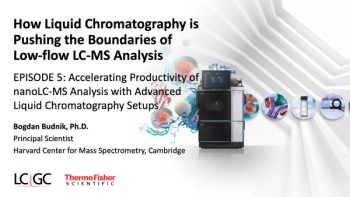
In the fifth episode of this six-part series, Bogdan Budnik, principal scientist at Harvard Center for Mass Spectrometry, discusses common challenges related to nano LCMS proteomics analysis of very diverse sample types, improvements in proteomics analysis, and how single-cell proteomics will impact the medical field.

In the final episode of this six-part podcast, Robert Moritz, a professor at the Institute for Systems Biology, discusses major challenges that still exist with liquid chromatography and mass spectrometry, liquid chromatography’s role in LC-MS proteomics, and where this field is headed in the next few years and beyond.