

|Articles|February 28, 2019
- LCGC Europe-03-01-2019
- Volume 32
- Issue 3
Supplementary Information: Middle-Up Characterization of the Monoclonal Antibody Infliximab by Capillary Zone Electrophoresis–Mass Spectrometry
This information is supplementary to the article “Middle-Up Characterization of the Monoclonal Antibody Infliximab by Capillary Zone Electrophoresis-Mass Spectrometry” that was published in the March 2019 issue of LCGC Europe.
Advertisement
This information is supplementary to the article “Middle-Up Characterization of the Monoclonal Antibody Infliximab by Capillary Zone Electrophoresis–Mass Spectrometry” that was published in the March 2019 issue of LCGC Europe.
Articles in this issue
over 7 years ago
Hydrophilic Interaction Liquid Chromatography: An Updateover 7 years ago
Vol 32 No 03 LCGC Europe March 2019 Regular Issue PDFover 7 years ago
The Rising Role of Foodomicsover 7 years ago
Hydrophobic Interaction Chromatography (HIC) of ProteinsAdvertisement
Related to this article

Ed Ahearne combined automation , machine learning and Bayesian optimization to speed up method development for siRNA medicines.

Data-independent acquisition (DIA) liquid chromatography-tandem mass spectrometry (LC–MS/MS) reveals shared and site-specific proteins across the thighbone.

Laura Righetti explains why quantification, not instrumentation, still keeps mass spectrometry imaging (MSI) out of routine food safety testing.

Large language models help chromatographers build LC pressure troubleshooting apps in hours.

Magnetic molecularly imprinted polymer extraction with liquid chromatography-high resolution mass spectrometry (LC–HRMS) finds patulin in store-bought juice.

Richard Bade and Malcolm McLeod explain to LCGC International how liquid chromatography-tandem mass spectrometry (LC-MS/MS) detects drug trends in wastewater.
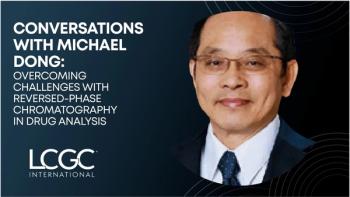
In this fifth part of " Conversations with Michael Dong," a series on fundamentals of HPLC in pharmaceutical analysis, LCGC International’s "Perspectives in HPLC" column editor discusses how to overcome challenges with reversed-phase chromatography in drug analysis.
Advertisement
Advertisement