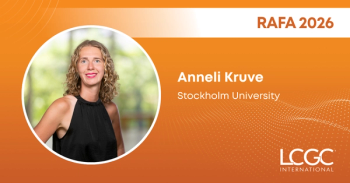
Anneli Kruve reports that toxicity predictions from MS2-derived molecular fingerprints outperform spectral-similarity methods in nontarget screening of food.
Erin Chambers connects trustworthy data to scientific confidence and describes how Waters builds regulatory readiness into development.
“The fundamental reality here is that if you've got questions about your data, a question like ‘Is there a co-eluting peak?’, you can't ask a question like ‘Is there a relationship between this structure, this modification, and the biology or the function?’”
— Erin Chambers, Global Vice President & General Manager, Consumables & Lab Automation, Waters Corporation
Erin Chambers, global vice president and general manager of Waters Corporation's consumables and lab automation business, ties data reliability directly to how far researchers are willing to push a scientific question. If a scientist is still uncertain whether a signal in their data is real or a coeluting artifact, she says, they cannot move on to ask a more consequential question about structure, modification, and biological function, a dynamic she sees playing out most acutely in biopharmaceutical development.
Asked how much of product development is shaped by anticipating regulatory demands versus responding to what scientists need today, Chambers says the two are not separate priorities: development is rooted first in direct customer conversations, but regulatory readiness is built into Waters products from the outset rather than added afterward. That reliability, she says, is what underpins the company's approach to regulatory readiness more broadly. Rather than treating compliance as a separate track, she describes it as built in through rigorous batch-to-batch testing and reproducibility standards, work that has led Waters columns to be specified directly into GLP-1 analytical methods. She points to impurities that can differ by a single atom or spatial arrangement as an example of the precision required, and frames the goal as consistency: getting the same answer every time, not just once. That focus on a dependable outcome, rather than a single data point, is what she says gives Waters products built-in readiness even before formal guidance catches up—readiness she describes as earned through testing history rather than added on at the last stage of development.
Chambers answered the following questions:
Watch the full interview clips here:
For more information on Waters, please click