This article describes the efficient development of robust analytical methods based on Analytical Quality by Design (AQbD) using dedicated LabSolutions MD software, which supports each phase of the process – screening, optimization, and validation – using functions such as experimental design, building of design space by automatic Peak Tracking, and robustness evaluation.
Ultrahigh-performance liquid chromatography–tandem mass spectrometry (UHPLC–MS/MS) tracks blood metabolite changes after repetitive transcranial magnetic stimulation (rTMS)-cognitive training therapy.
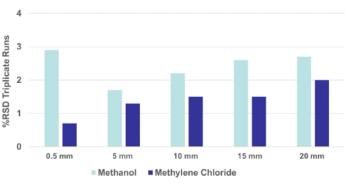
Revisiting insertion distance for methanol and methylene chloride in GC analysis and confirming that insertion depth strongly affects response and reproducibility.
A novel SFC–QTOF-MS method accurately detected 10 drugs in oral fluid, matching LC–MS/MS in 83 DUID cases while reducing run time by 42% and organic solvent use by 81%.
Supercritical fluid extraction (SFE) and high-pressure liquid chromatography (HPLC) team up to recover olive waste antioxidants. Marina Russo of the University of Messina (Italy) discusses the details.
Waters' Erin Chambers says combining column chemistry and particle-physics innovation cut a GLP-1 impurity profiling workflow from three hours to under one.