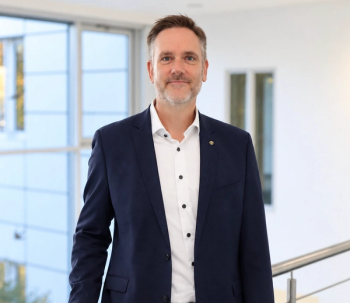
Florian Geistmann succeeded retiring Jürgen Semmler as Shimadzu Europa managing director on October 1.
Welcome to “From Sample to Verdict: The Role of Chromatography in Forensic Analysis.”
On this landing page, you will find a compilation of expert interviews specifically curated for National Forensic Science Week. Happy reading!
J. Tyler Davidson, from the Department of Forensic Science at Sam Houston State University (Huntsville, Texas), recently explored the use of liquid chromatography–electrospray ionization–tandem mass spectrometry (LC–ESI–MS/MS) to characterize 38 nitazene analogs. His study proposed fragmentation mechanisms that yield diagnostic product ions to aid in distinguishing between these analogs (1). LCGC International spoke with Davidson about his research and the resulting publication.
In this interview, Petr Vozka discusses how comprehensive two-dimensional gas chromatography coupled with time-of-flight mass spectrometry (GC×GC–TOF-MS) can uncover time-dependent chemical changes in fingerprints. This approach enables fingerprint age estimation through chemometric modeling, offering a powerful advancement to forensic timelines beyond conventional ridge pattern analysis (2).
As part of “From Sample to Verdict,” LCGC International sat down with Procopio to discuss her team’s work. In Part I of our conversation, she discusses the development of the Forens-OMICS approach and how her team estimates PMI using metabolomics, proteomics, and metabarcoding (3).
As part of “From Sample to Verdict,” LCGC International sat down with Furton to discuss his team’s work at the Global Forensic and Justice Center. In Part I of our conversation, he provides an overview of his work in environmental forensics, including applying solid-phase microextraction (SPME-GC–MS) in distinguishing crude oil sources (4).
A recent study examined early post-mortem volatile organic compounds (VOCs) released from human donors in an outdoor environment. Employing comprehensive two-dimensional gas chromatography–time-of-flight mass spectrometry (GC×GC–TOFMS), the research tracked VOC changes to identify the transition from ante-mortem to post-mortem odor. LCGC International spoke with Darshil Patel, lead author from the University of Windsor, about his team’s findings (5).
Recently, researchers at the Georgia Bureau of Investigation Division of Forensic Sciences validated a salt-assisted liquid–liquid extraction (SALLE) method coupled with liquid chromatography–tandem mass spectrometry (LC–MS/MS) for the detection of amphetamine-type stimulants (ATS) and cocaine metabolites in forensic toxicology. LCGC International spoke with Jon Stephenson of the Division about the study (6).
Using a streamlined filter-and-shoot method, Matteo Gallidabino, a Lecturer in Forensic Chemistry at King’s College London and a core member of the King’s Forensics group, and his team measured levels of three common additives, diphenylamine (DPA), dibutyl phthalate (DBP), and ethyl centralite (EC), and found a strong linear relationship between the amount handled and residue recovered. These data enabled the development of regression models to estimate expected residue levels, supporting more robust and evidence-based interpretations in investigations involving suspected SLP handling. As part of “From Sample to Verdict,” Gallidabino sat down with LCGC International to discuss his study’s findings.
In this interview, Kevin Schug of the University of Texas at Arlington discusses the current progress of limitations in forensic blood alcohol testing and how chromatography is being used to address these challenges (8).
A recent study introduced a 32-element metal oxide semiconductor (MOS)–based electronic nose (e-nose) combined with advanced supervised machine learning (ML) algorithms for forensic applications. The approach enables differentiation between human and animal samples, distinction of postmortem and antemortem states, and estimation of postmortem intervals. LCGC International spoke with Donatella Puglisi, associate professor at Linköping University and corresponding author of the resulting paper (9).
Rick S. van den Hurk and Bob Pirok of the van ’t Hoff Institute for Molecular Sciences at the University of Amsterdam discuss how multidimensional liquid chromatography is used to analyze traces of explosives (10).
Ed Sisco and Sarah Shuda, research chemists at the National Institute of Standards and Technology (NIST), provide an overview of their work advancing forensic science (11).
In this interview, Ida Marie Marquart Løber discusses how UHPLC–QTOF-MS combined with ML can aid postmortem interval estimation, demonstrating its use in profiling rat tissue metabolites and mapping potential pathways for adapting the approach to human forensic timelines (12).
Maria Olds of the University of Texas at Arlington explored the preanalytical factors that can affect ethanol analysis in human samples. In part one of our interview with Olds, she discussed why using headspace (HS) gas chromatography (GC) with a flame ionization detector (FID) the preferred method of ethanol analysis in human blood and urine (13).
Maria Olds of the University of Texas at Arlington explored the preanalytical factors that can affect ethanol analysis in human samples. In part two of our interview with Olds, she discusses the consequences of not accounting for preanalytical factors in blood alcohol concentration (BAC) analysis (14).