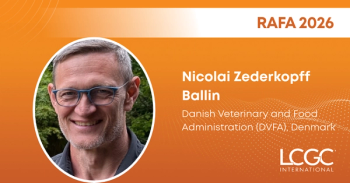
Nicolai Zederkopff explores chromatography’s role to help implement the maximum tolerable level (MTL) framework for food adulteration to translate analytical results into compliance decisions.
Kevin Schug explores how molecular encoding bridges chemistry and data science to enhance precision and intelligence in analytical measurements.
At analytica 2026 in Munich, Germany, LCGC International spoke with Kevin Schug about his presentation: "Molecular Encoding as a Tool to Enable Data Science-Assisted Analytical Measurements."1
Molecular descriptors allow molecules to be encoded as numerical vectors, enabling their incorporation into prediction and optimization algorithms. Molecules can be described using structural, topological, and physicochemical descriptors, with the choice of encoding determined by the properties most relevant to the process under investigation. Schug's research has applied this approach to two areas: predicting gas-phase vacuum ultraviolet–ultraviolet (VUV–UV) absorption spectra using machine learning, and evaluating molecular diversity and similarity in the context of analytical extractions and separations. A new encoding method called cumulative binarization has also been developed as part of this work, offering greater granularity in distinguishing between molecules.
In this video interview, Schug answers the following question:
Schug has written extensively on the role of AI and data science in analytical chemistry in the LCGC Blog. In a recent instalment, "Artificial Intelligence: The Good, The Challenging, and The Terrifying", he reflects on the transformative potential of AI for the field—and the broader societal questions it raises.2
Kevin A. Schug is a full professor and Shimadzu Distinguished Professor of Analytical Chemistry in the Department of Chemistry & Biochemistry at The University of Texas (UT) at Arlington. He joined the faculty at UT Arlington in 2005 after completing a Ph.D. in chemistry at Virginia Tech under the direction of Harold M. McNair and a post-doctoral fellowship at the University of Vienna under Wolfgang Lindner. Research in the Schug group spans fundamental and applied areas of separation science and mass spectrometry.