News|Articles|June 13, 2025
- June 2025
- Volume 21
- Issue 2
- Pages: 6
Key Trends Shaping the Food Analysis Market
Author(s)Caroline Hroncich
Advertisement
Advertisement
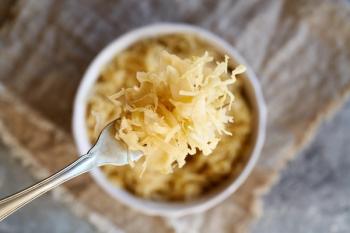
If you’ve browsed the aisles of high-end grocery stores like Whole Foods lately, you may have noticed jars of
Related to this article

Derivatization-based liquid chromatography–tandem mass spectrometry (LC–MS/MS) preserves the O–O bond for specific hydrogen peroxide detection.

Sarah Foster’s principal component analysis of mead fermentation kinetics found Brix drove separation, with mean centering the best preprocessing.

Liquid chromatography–mass spectrometry (LC–MS) proteomics shows spreading colorectal and pancreatic tumors differ.

Sarah Foster found Abbaye yeast meads clustered apart in PCA and HCA, driven by furfural, ethyl octanoate, ethyl decanoate, and furan-2,5-dicarbaldehyde.

Gas chromatography–mass spectrometry (GC–MS) links Lactococcus and Enterococcus to fruity esters in sauerkraut.

Tuned liquid chromatography–tandem mass spectrometry (LC–MS/MS) separation beats brain matrix effects to quantify psilocin.

Hanrong Wen, Ken Broeckhoven, and Sebastiaan Eeltink of VUB discuss how sub-1 µm particle columns could boost LC performance, and the hurdles to adoption.
Advertisement
Advertisement