

The Application Notebook
Polymer Char
The Application Notebook
Polymer Char

Special Issues
The analysis of the amorphous fraction is a fundamental task in the production of polypropylene.

The Application Notebook
Malvern Instruments Ltd.


The Application Notebook
Shodex/Showa Denko America Inc.
The Application Notebook
Malvern Instruments Ltd.

The Application Notebook
Tosoh Bioscience LLC

The Application Notebook
New roles and applications in the areas of science and technology are continuously being found for synthetic polymers. Specifically, the use of synthetic polymers in medicine is growing, as these polymers offer unique and versatile platforms for applications such as implants, medical devices, surgical adhesives, drug delivery vesicles, and injectable polymer-drug conjugates (1,2). As the applications of synthetic polymers increases, there is a manifested need for methods to accurately and precisely characterize the materials.

The Application Notebook
Blockcopolymers such as SBS (styrene-butadiene-styrene) are an important product class and a typical example of complex polymers. In addition to the molar mass distribution, a chemical composition distribution may also be present in copolymers. While GPC–SEC is the established method for the determination of molar mass averages and distribution, gradient HPLC can be applied to separate based on chemical composition.

The Application Notebook
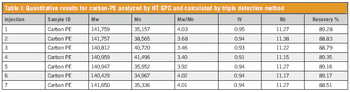
Gel permeation chromatography (GPC), also referred to as size exclusion chromatography (SEC), when applied to polyolefins analysis (Polyethylene, PE and Polypropylene, PP) has been considered a demanding task due to the high temperature required for operation and the use of hazardous chlorinated solvents for resin dissolution.

The Column
This article discusses GPC and gives examples of the use of the technique in excipient analysis.

The Application Notebook
Polymer Char Application Note
LCGC Europe
A GC–MS analyser is described that is reported to substantially expand the workable application range of a classic catalyst contaminants analyser. The use of FS/SIM mode permits identification of unknown contaminants in combination with reliable quantification at trace and ultratrace amounts.

LCGC Asia Pacific
Describes the preparation of a reversed-phase monolithic column with an optimized porous structure to separate intact proteins using LC–MS.
The Application Notebook
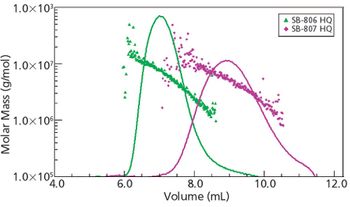
Size exclusion chromatography (SEC) is a simple HPLC technique used for the molecular weight (MW) distribution analysis of polymers. Several manufacturers provide SEC columns with different base materials and various pore sizes to cover a wide range of polymer analysis.

The Application Notebook
Resistive glass tubes and plates are designed to guide ions by generating a uniform electric field. PHOTONIS resistive glass products are composed of a proprietary lead silicate glass that has been specially processed to create a resistive layer at the surface. The resistivity can be varied over several orders of magnitude to suit the specific application.

LCGC Europe
Describes the preparation of a reversed-phase monolithic column with an optimized porous structure to separate intact proteins using LC–MS.

The Application Notebook
Polymer Chas Application Note

LCGC Europe
Describes how asymmetrical flow field flow fractionation (AF4) can be used to characterize intermolecular interactions in multifunctional polymers used in drug delivery.

LCGC Asia Pacific
In this review, practical principles and guidelines for designing LC?LC methods are given.

LCGC Europe
In this review, practical principles and guidelines for designing LCxLC methods are given.

The Column
Tips and Tricks: GPC/SEC Copolymer Analysis in GPC/SEC 3: Two-dimensional Chromatography

The Application Notebook
Complete high resolution cross-fractionation of Polyolefins in the molar mass and composition dimensions is achieved with a new benchtop CFC analytical instrument.

The Application Notebook
Synthetic and natural materials are used in motor vehicles to provide appealing and safe vehicle interiors. The manufacturing process for these materials include volatile (VOC) and semi volatile organic compounds (SVOC), which are released into the interior of vehicles. These compounds produce that new smell, but also create fog on interior glass surfaces of the car and can cause health issues.

The Column
The authors look at comprehensive two-dimensional gas chromatography as a choice for the quantitative speciation of trace alkyl phosphates in petroleum samples.
The Application Notebook
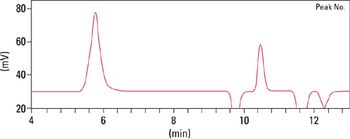
The EcoSEC GPC System and a set of TSK-GEL mixed-bed columns, both available from Tosoh Bioscience, were used successfully for obtaining high quality MWD data of a series of block poly-β-alkylalanoids with HFIP as the mobile phase in under 15 min.

The Application Notebook
Pyrolysis GC?MS is a valuable tool for the material scientist. It is used principally for qualitative identification of polymers and their breakdown products. This application note displays how this technique can also be used for quantitative determination of polymer compositions by comparing peak area ratios of monomers and/or primary pyrolysis products.
In this article, the authors describe a pyrolysis technique that is based on the injection of polymer emulsions or solutions using a high-temperature PTV system.

LCGC Asia Pacific
Polymer Char Application Note

The Column
Questions answered on a conservation project for historical costumes.