HTC-17 will be held in person from 18 to 20 May 2022, at The Aula in Ghent, Belgium. Here’s a taste of what to expect.
HTC-17 will be held in person from 18 to 20 May 2022, at The Aula in Ghent, Belgium. Here’s a taste of what to expect.

HTC-17 will be held in person from 26 to 28 January 2022, at Conference Center Het Pand in Ghent, Belgium. Here’s a taste of what to expect.

The 17th International Symposium on Hyphenated Techniques in Chromatography and Separation Technology (HTC-17) will be held in person from 26 to 28 January 2022, at Conference Center Het Pand in Ghent, Belgium. HTC-17 will be organized under the auspices of the Royal Flemish Chemical Society (KVCV) and the Separation Science Group of the Royal Society of Chemistry (SSG RSC).

LCGC Europe
The main objective of this review article is to provide a clear summary of the different methods that can be used to quantify endogenous small molecules. Because of the increased use of mass spectrometry (MS) in the field of bioanalysis, a special focus will be placed on quantification by liquid chromatography (LC)–MS. Practical recommendations to face this bioanalytical challenge, in particular in terms of method validation, will also be provided.
LCGC Asia Pacific
The main objective of this review article is to provide a clear summary of the different methods that can be used to quantify endogenous small molecules. Because of the increased use of mass spectrometry (MS) in the field of bioanalysis, a special focus will be placed on quantification by liquid chromatography (LC)–MS. Practical recommendations to face this bioanalytical challenge, in particular in terms of method validation, will also be provided.

Special Issues
The packed particle bed format still rules LC columns, but advances continue in monoliths. Meanwhile, newer formats are on the horizon, including microfabricated columns and 3D printed columns. This article provides a critical review of all these technologies and demonstrates how further development of chromatographic columns will be of paramount importance in the future.

LCGC Europe
In this extended special feature to celebrate the 30th anniversary edition of LCGC Europe, leading figures from the separation science community explore contemporary trends in separation science and identify possible future developments. We asked key opinion leaders in the field to discuss the current state of the art in liquid chromatography instruments.
Special Issues
An introduction from the guest editor of this special supplement from LCGC Europe and LCGC North America revealing recent developments in high performance liquid chromatography (HPLC) and ultrahigh-pressure liquid chromatography (UHPLC).

LCGC North America
There is increasing demand to analyze samples with a wide range of polarities, in fields such as environmental analysis and proteomics.
LCGC Asia Pacific
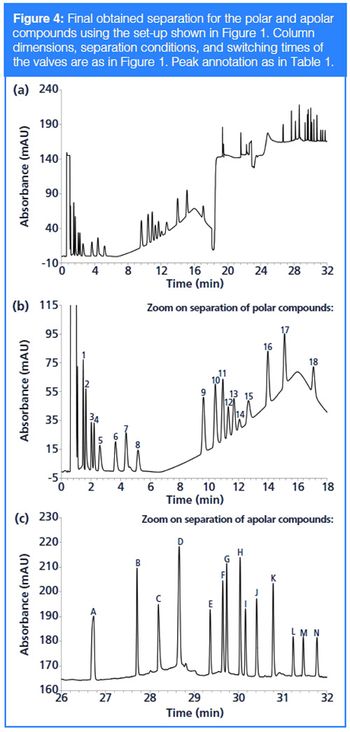
Appropriate analytical methods are required to evaluate the presence, metabolism, degradation, and removal of specific compounds in complex mixtures. There is an increasing demand to analyze samples with a wide range of polarities in a variety of applications, including environmental analysis, biomarker discovery, and proteomics. Multiple analyses on complementary columns are often needed to cover the separation of all compounds with a large difference in polarity. This article describes a generic method involving an ultrahigh‑pressure liquid chromatography (UHPLC) system equipped with two external switching valves to connect hydrophilic interaction liquid chromatography (HILIC) and reversed-phase LC columns in series for the sequential analysis of polar and apolar compounds.

LCGC Europe
Appropriate analytical methods are required to evaluate the presence, metabolism, degradation, and removal of specific compounds in complex mixtures. There is an increasing demand to analyze samples with a wide range of polarities in a variety of applications, including environmental analysis, biomarker discovery, and proteomics. Multiple analyses on complementary columns are often needed to cover the separation of all compounds with a large difference in polarity. This article describes a generic method involving an ultrahigh-pressure liquid chromatography (UHPLC) system equipped with two external switching valves to connect hydrophilic interaction liquid chromatography (HILIC) and reversed-phase LC columns in series for the sequential analysis of polar and apolar compounds. The method was successfully applied to separate 32 pharmaceutical compounds with a wide range of polarities, which could be useful for analyzing pharmaceutical compounds in the environment.

LCGC Europe
The throughput of a lab can be optimized with the optimum particle diameter and column length for a specific stationary phase.

LCGC Europe
Using a fixed length-variant of the kinetic plot method, it is illustrated how an analysis that is performed near the optimal flow-rate of a given commercial column can, in many cases, be performed between 50–200% faster by switching to a longer column and operating it at a higher pressure - at least, if the available instrument pressure admits so. The present article aims to show that short columns are not always the best choice to get the fastest separation.

May 6th 2021

February 1st 2009