LCGC International spoke to the HTC-19 Organizing Committee about what delegates can expect to at HTC-19, which will be held in Leuven, Belgium, from May 26–29, 2026.
Ken Broeckhoven is a professor at Vrije Universiteit Brussel, Belgium.
LCGC International spoke to the HTC-19 Organizing Committee about what delegates can expect to at HTC-19, which will be held in Leuven, Belgium, from May 26–29, 2026.

The 54th International Symposium on High Performance Liquid Phase Separations and Related Techniques (HPLC 2025) will be held from Sunday through Thursday, 15–19 June, 2025, in Bruges, Belgium.
Here's a taster of what to look forward to at the 54th International Symposium on High Performance Liquid Phase Separations and Related Techniques (HPLC 2025), which will be held from Sunday through Thursday, 15–19 June, 2025, in Bruges, Belgium.
The 54th International Symposium on High Performance Liquid Phase Separations and Related Techniques (HPLC 2025) will be held from Sunday through Thursday, June 15-19, 2025, in Bruges, Belgium.
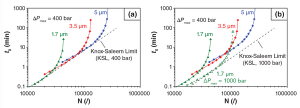
Although smaller advances have been made in the past decades, the question remains whether further extending operating pressure and decreasing particle size remains a feasible approach, or whether drastically novel approaches are required.

The impact of extracolumn dispersion on kinetic plot curves is investigated. A web-based calculator that allows users to make their own kinetic plots with examples of how the tool can be used to troubleshoot underperforming columns and support column selection is discussed.

A kinetic plot is a powerful tool, but how do you construct one—from either experimental data or data from other sources? We explain.

With kinetic plots, you can make better-informed column choices. Here’s how.

Kinetic plots can help us understand how different combinations of parameters will perform in relation the time needed to acquire a particular column efficiency—and thus resolution.

A kinetic plot is a powerful tool, but how do you construct one—from either experimental data or data from other sources? We explain.

Kinetic plots can help us understand how different combinations of parameters will perform in relation the time needed to acquire a particular column efficiency—and thus resolution.
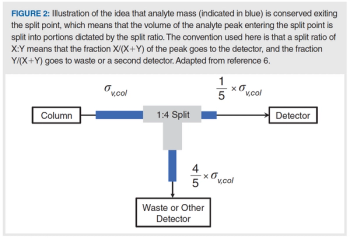
In this instalment, we focus on the impact of elution mode (isocratic or gradient) and postcolumn flow splitting on the total level of extracolumn dispersion (ECD) in a liquid chromatography (LC) system, and demonstrate the use of a free, web-based calculator that can be used to guide decision making aimed at reducing ECD during method development.
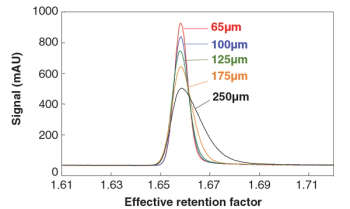
In recent articles, the authors reviewed the basic concepts of extracolumn dispersion and how this phenomenon can impact the quality of an LC separation. We now specifically discuss the effects of dispersion that can occur due to tubing and detectors.

In the final article of this series on extracolumn dispersion, we look at elution mode, post-column flow splitting, and a free calculator to use during method development.

Dispersion of analyte peaks outside of chromatography columns can seriously erode the resolution provided by good columns. Here, we focus on the contribution of the sample injection step to the total level of extracolumn dispersion in an LC system.

In recent articles, we reviewed the basic concepts of extracolumn dispersion and how this phenomenon can impact the quality of an LC separation. We now specifically discuss the effects of dispersion that can occur due to tubing and detectors.
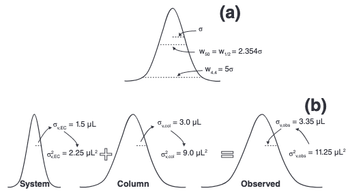
This instalment focuses on basic concepts in extracolumn dispersion (ECD) that occurs in high performance liquid chromatography (HPLC) systems, and the impact of this dispersion on the performance of columns of different dimensions and efficiencies.

Dispersion of analyte peaks outside of chromatography columns can seriously erode the resolution provided by good columns. Here, we focus on the contribution of the sample injection step to the total level of extracolumn dispersion in an LC system.

Dispersion of analyte zones outside of the column often compromises the quality of an LC separation—particularly in smaller columns with smaller particles. We explain basic concepts in extra-column dispersion from the point of view of an entire instrument.
LCGC Europe
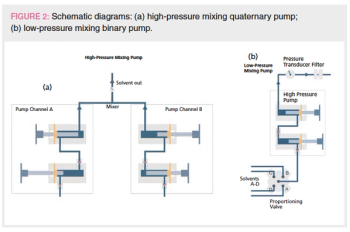
This instalment is the first of a series of four white papers on high performance liquid chromatography (HPLC) modules (pump, autosampler, UV detector, and chromatography data system) to be published in 2019. This instalment provides an overview for analytical-scale HPLC pumps, including their requirements, modern designs, operating principles, trends, and best practices for trouble-free operation.

LCGC North America
Gaining a solid understanding of how HPLC instrumentation works will help you achieve success in the analytical laboratory. This four-part series is here to guide you, starting with pumps.

Special Issues
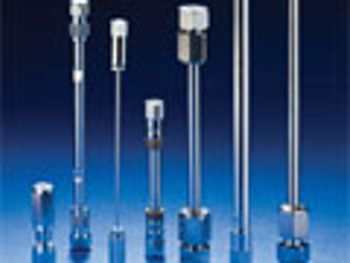
The packed particle bed format still rules LC columns, but advances continue in monoliths. Meanwhile, newer formats are on the horizon, including microfabricated columns and 3D printed columns. This article provides a critical review of all these technologies and demonstrates how further development of chromatographic columns will be of paramount importance in the future.

LCGC Asia Pacific
The last decade has witnessed how liquid chromatography columns and instruments changed from long bulky columns with relatively large fully porous particles operated at modest pressures (100Ð200 bar), to short compact columns with small superficially porous particles operated at ultrahigh pressures (1200Ð1500 bar). This (r)evolution has resulted in a tremendous increase in achievable separation performance or decrease in analysis time, but requires a good knowledge of optimal chromatographic conditions for each separation problem and, concomitant, the right instrument configuration.

LCGC Europe
The last decade has witnessed how liquid chromatography columns and instruments changed from long bulky columns with relatively large fully porous particles operated at modest pressures (100–200 bar), to short compact columns with small superficially porous particles operated at ultrahigh pressures (1200–1500 bar). This (r)evolution has resulted in a tremendous increase in achievable separation performance or decrease in analysis time, but requires a good knowledge of optimal chromatographic conditions for each separation problem and, concomitant, the right instrument configuration.

LCGC Europe
Some 50 years after Giddings’s iconic comparison of the separation speed of gas chromatography (GC) and liquid chromatography (LC), the authors revisit this comparison using kinetic plots of the current state‑of‑the-art systems in LC, supercritical fluid chromatography (SFC), and GC. It is found that, despite the major progress LC has made in the past decade (sub-2-µm particles, pressures up to 1500 bar, core–shell particles), a fully optimized ultrahigh-pressure liquid chromatography (UHPLC) separation is still at least one order of magnitude slower than capillary GC. The speed limits of packed bed SFC are situated in between.
LCGC North America
Analysis time can be reduced 10–30% by switching from constant-flow-rate mode to a constant-pressure gradient-elution mode.

LCGC Europe
The throughput of a lab can be optimized with the optimum particle diameter and column length for a specific stationary phase.