
Discover LC–MS chromatography strategies that tackle PFAS at ppt levels in soil, serum and food, boosting sensitivity, selectivity and confidence.

Daniel Eßer studied chemistry at the University of Applied Sciences Bonn Rhein-Sieg, in Rheinbach, Germany, with a focus on pharmaceutical and analytical chemistry. He received his Ph.D. in pharmaceutical and medicinal chemistry at the University of Düsseldorf, Germany. During his postdoc at the Institute of Pharmaceutical and Medicinal Chemistry of the University of Düsseldorf, he established a nanoLC–MS system. In 2013 he joined YMC Europe as a product specialist for analytical chromatography. Since 2017, he has been responsible for YMC’s analytical (U)HPLC column portfolio as product manager for analytical chromatography.
Discover LC–MS chromatography strategies that tackle PFAS at ppt levels in soil, serum and food, boosting sensitivity, selectivity and confidence.
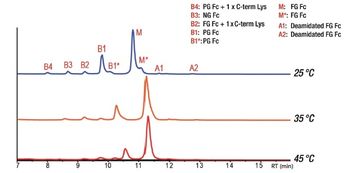
This article discusses the advantages of a native anion exchange method coupled to mass spectrometry (MS) for charge heterogeneity analysis of immunoglobulin G4 (IgG4)-based mAbs, which are currently being studied more intensively.

This article discusses several practical examples using bioinert columns, demonstrating their ability to deliver reliable, high-resolution results with precision and reproducibility.

This article describes a comprehensive study on optimizing ion-pair reversed-phase liquid chromatography for analysing protected and unprotected single-stranded DNA oligonucleotides.

The advantages of a native anion exchange method coupled to mass spectrometry for charge heterogeneity analysis of immunoglobulin G4 (IgG4)-based mAbs are described.

What parameters can influence an siRNA separation?

This article discusses the main influences in oligonucleotide analysis using ion-pair (IP) reversed-phase chromatography.


