The Application Notebook
Dionex Application note
The Application Notebook
Dionex Application note
The Application Notebook
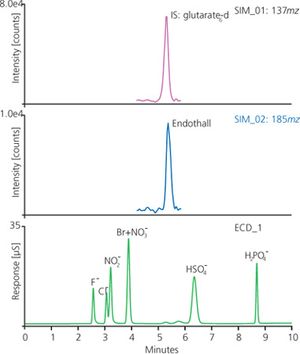
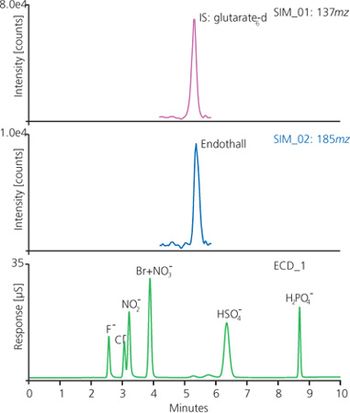
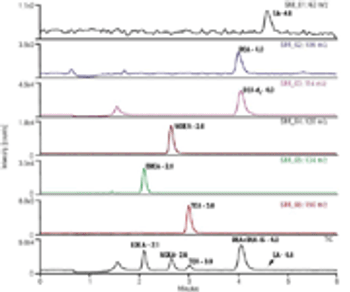
Endothall is a widely used herbicide for both terrestrial and aquatic weeds. Exposure to endothall in excess of the maximum contamination level (MCL) can cause illness. Endothall is regulated by the U.S.
The Application Notebook
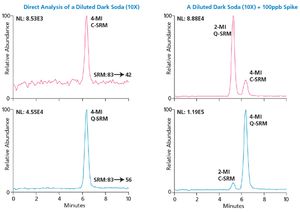
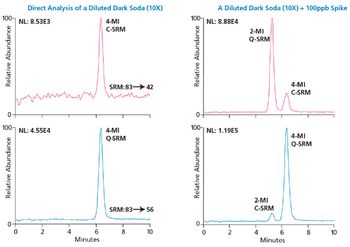
The chemicals 2- and 4-methylimidazole (2-MI and 4-MI) are by-products produced during the manufacturing of caramel coloring ingredients used to darken food products such as carbonated beverages and soy sauce.
The Application Notebook
Dionex Application note
The Application Notebook
Bisphenol A (BPA) is widely used in high production volume manufacturing of polycarbonate plastics (for example, food containers and plastic bottles) and epoxy resins.

The Application Notebook
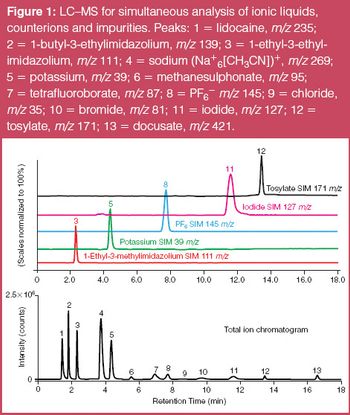
The term ionic liquid refers to organic salts with relatively low melting points (below 100 °C) that usually consist of an organic cation or anion and a counterion, in either organic or inorganic form. Ionic liquids exhibit unique characteristics such as extremely low vapour pressure, excellent thermal stability, electrical conductivity, a high degree of polarity and miscibility with various types of solvents. Ionic liquids have been used as catalysts and solvents in organic chemistry and electrochemistry and as mobile phase modifiers or functionalized stationary phases in separation science.1–3
The Application Notebook
The term ionic liquid refers to organic salts with relatively low melting points (below 100 °C) that usually consist of an organic cation or anion and a counterion, in either organic or inorganic form.
Special Issues
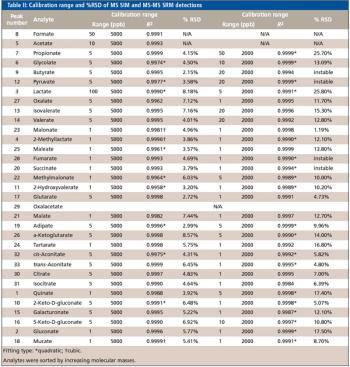
Organic acids are present in many media and play various crucial roles. Low molecular mass organic acids (LMMOAs) have been researched extensively in many areas, such as food chemistry, as these acids affect taste, shelf-life, and food safety (1–3); agriculture, ecosystems, and environmental science, as these acids act as key components in mechanisms that some plants use to cope with environmental stress (4) and fertilizer release (5); biotechnology, to better understand and optimize fermentation processes (6,7); and biomedical research (8–11). Recently, LMMOAs were found to have inhibitory effects on the bioconversion efficiencies of lignocelluloses to ethanol (12).

The Application Notebook
Tobacco Specific Nitrosamines (TSNA) are a group of carcinogens found only in tobacco products and are formed from nicotine and related alkaloids during the production and processing of tobacco and tobacco products (1). Due to their carcinogenic properties, efforts have been made to reduce TSNA levels in tobacco products. The project goal was to demonstrate a high throughput and sensitive method to monitor TSNA levels.
The Application Notebook
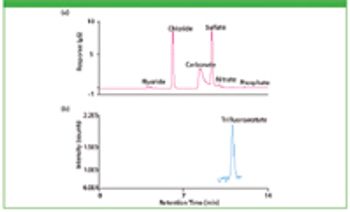
Perflourinated organic acids are ubiquitous and found at relatively low concentrations in the environment (1). Trifluoroacetic acid (TFA) is the persistent atmospheric degradation product of hydrofluorocarbons (HFCs) that are increasingly used as an alternative to banned, ozone-damaging chlorofluorocarbons (CFCs). However, debate surrounds the use of HFCs because of their potential to contribute to global warming and demonstrated toxicity to the environment (2). TFA is also widely used in pharmaceutical and biotechnology purification processes. It is crucial to monitor for TFA in environmental risk assessment and in products intended for human use. TFA can be measured by gas chromatography (GC) after sample preparation and chemical derivatization (3), ion chromatography (IC) (4), and capillary electrophoresis (5). This paper describes an IC-MS method to separate TFA from common anions based on Reagent-Freeâ„¢ IC (RFICâ„¢) technology with sensitive and selective mass spectrometric detection.

The Application Notebook
Organic acids are present in many matrices and play crucial roles. Extensive research involving low molecular mass organic acids (LMMOA) has been performed in food chemistry since these acids contribute to the organoleptic properties of food and beverages, including flavor, color, aroma, taste, shelf-life, and health effects. Developing a profiling method to monitor LMMOA levels in raw materials and final products is very desirable. Many reported methods focus on limited numbers of LMMOAs and are incapable of providing a complete LMMOA profile.


August 2nd 2011

March 1st 2011