
Sponsored Content - NA
Quantitation of residual solvents in food packaging by automated headspace–trap GC–MS
Sponsored Content - NA
Quantitation of residual solvents in food packaging by automated headspace–trap GC–MS
Sponsored Content - EU
Enhanced aroma profiling of vodka using automated immersive high-capacity sorptive extraction with GC–MS
Sponsored Content - EU
This study shows the advantages of automated immersive sorptive extraction for the GC–MS analysis of a wide range of aroma compounds in vodka.
Sponsored Content - NA
This study shows the advantages of automated immersive sorptive extraction for the GC–MS analysis of a wide range of aroma compounds in vodka.
Sponsored Content - EU
Data acquired using the Centri® automated multi-mode sampling and preconcentration system for GC–MS can be used to generate insights into the aroma profiles of foods.


Special Issues
This study shows that the organic compounds giving rise to the flavor of beverages can be identified by high-capacity sorptive extraction using PDMS probes, wih analysis by thermal desorption–GC–MS.
LCGC Europe
This application note demonstrates that Markes International’s automated thermal desorption systems offer excellent results for monitoring volatile organic compounds (VOCs) in stationary source emissions in accordance with the updated version of the European standard method CEN/TS 13649 released in 2014. The value of repeat analysis for method development and result verification is also demonstrated.
What is thermal desorption and how can it extend the capability of GC? In this podcast, you’ll hear the answers to these questions directly from Elizabeth Woolfenden, a leading expert on this sample introduction technique. As a co-founder of Markes International, widely acknowledged as the world leaders in TD, Elizabeth has been right at the heart of the development of thermal desorption, and will draw on her experience to highlight the scope of the technique, along with key technical innovations and emerging applications. So whether you’re new to TD and want a quick introduction, or an experienced analyst interested in hearing a personal perspective, don’t miss this unique opportunity to get the lowdown on thermal desorption from a major player in the area!
LCGC North America
In May the EU tobacco products directive became applicable setting out rules governing the manufacture, presentation and sale of tobacco and related products, and the US FDA extended its authority over regulation of tobacco products to include electronic nicotine delivery systems (ENDS) such as e-cigarettes. This Application Note describes a versatile screening method for tackling the challenge of regulatory compliance and quality control in this rapidly expanding industry.
LCGC Europe
In May the EU tobacco products directive became applicable setting out rules governing the manufacture, presentation and sale of tobacco and related products, and the US FDA extended its authority over regulation of tobacco products to include electronic nicotine delivery systems (ENDS) such as e-cigarettes. This Application Note describes a versatile screening method for tackling the challenge of regulatory compliance and quality control in this rapidly expanding industry.
LCGC North America
This Application Note demonstrates the enhanced separation and unparalleled sensitivity that can be achieved in the characterisation of cigarette smoke GC×GC with BenchTOF time-of-flight mass spectrometry, aided by Tandem Ionisation for simultaneous acquisition of hard and soft EI data.
LCGC Europe
This poster describes how GC×GC–TOF MS is used to quickly and confidently identify key flavour compounds in tea and coffee that would be subject to extensive co-elution in a conventional GC–MS system.
LCGC Europe
Demonstrating how the excellent sensitivity, stability and high-quality spectra produced by TOF MS can provide a rapid and robust solution for the quantitative analysis of environmental contaminants.
LCGC North America
This Application Note describes the comparison of complex hop aroma profiles by GC–MS, and the identification of aroma-active terpenoids aided by soft electron ionisation.
LCGC Europe
This Application Note describes the comparison of complex hop aroma profiles by GC–MS, and the identification of aroma-active terpenoids aided by soft electron ionisation.
The Application Notebook
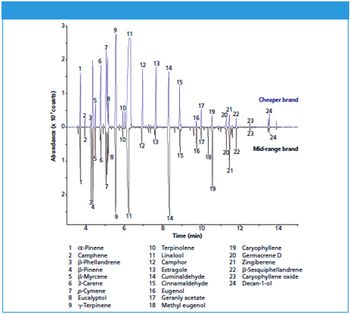
Herbs and spices are used in many food preparations, and identifying the differences between samples is of particular interest to manufacturers, both for ongoing quality control and to compare their products against competitors. However, the volatile organic compound (VOC) profiles of such samples often differ in the relative abundance of key components, and these differences can be difficult to assess by traditional methods such as solvent extraction, equilibrium headspace, or solid-phase microextraction (SPME).
The Application Notebook
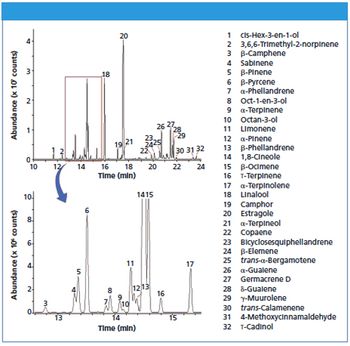
Herbs are widely used in many food products, but substantial variations in aroma can result from differences in growing conditions or preparation of the plant material, which can affect product quality.