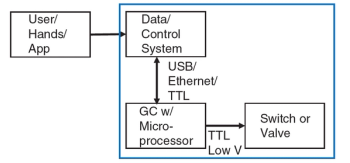
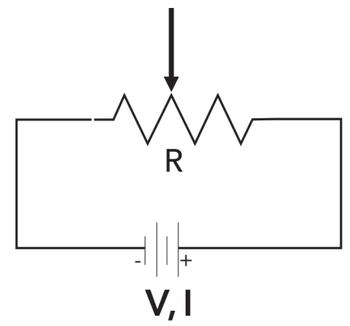
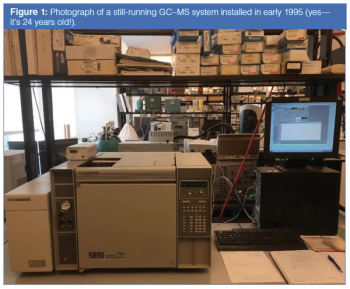
A look at how the data system controls the functions of the instrument. The same fundamental electronic principles used to manually control gas chromatographs in the 1970s are still at the center of today’s modern electronically controlled systems.

Nicholas H. Snow is the Founding Endowed Professor in the Department of Chemistry and Biochemistry at Seton Hall University, and an Adjuncy Professor of Medical Science. During his 30 years as a chromatographer, he has published more than 70 refereed articles and book chapters and has given more than 200 presentations and short courses. He is interested in the fundamentals and applications of separation science, especially gas chromatography, sampling, and sample preparation for chemical analysis. His research group is very active, with ongoing projects using GC, GC-MS, two-dimensional GC, and extraction methods including headspace, liquid-liquid extraction, and solid-phase microextraction. Direct correspondence to: LCGCedit@mmhgroup.com


A look at how the data system controls the functions of the instrument. The same fundamental electronic principles used to manually control gas chromatographs in the 1970s are still at the center of today’s modern electronically controlled systems.

Capillary GC has been miniaturized, while maintaining some performance aspects of full-size laboratory systems. The benefits and challenges involved with considering these newer, smaller gas chromatographs for typical analytical problems are discussed.

Mass spectrometry (MS) is the most powerful detector available for gas chromatography (GC). This article reviews the fundamentals of MS/MS and how they relate to MS as a detector for GC, then examines scenarios where use of GC–MS/MS can solve complex problems.

By moving from GC–MS to GC–MS/MS, you can have both universal and selective detection along with low detection limits. Here’s how it works.

Many chromatographic methods are automatically performed by today’s data systems, yet trace their origins to early, simpler techniques. This piece discusses how our data systems both assist and hinder in obtaining maximum information from chromatograms.

For GC, how do data systems both assist and hinder us in obtaining maximum information from chromatograms? We explain how a chromatogram can provide a wealth of information about an individual analyte in a sample, about the sample itself, and about how well a GC instrument is performing.

This instalment explores how the data system controls the functions of the GC instrument. Drawing on classical electronics and instrument designs, the article describes the evolution of instrument controls from knobs and gauges on the front panel of the instrument to computer control and current web-based systems.

Computers control all aspects of modern GC instrument operation, from temperature to valve actuation. We look under the hood to see how this works.

Using the flame ionization detector (FID) as an example, we explain how the detector in a GC system generates a signal and how it is processed into chromatograms, and explore modern aspects of storing and processing digital data.

Gas chromatographs today are easy to use. With modern web-based controls and data analysis, you don’t even have to be in the laboratory to run the instrument and collect the data. In this first instalment on how this magic happens, we discuss signal generation and processing from a classical flame ionization detector (FID), so that you can use the data to make decisions.

In gas chromatography, heating the sample in the inlet can lead to sample losses and loss of quantitative reproducibility, but these problems can be avoided using cold sample introduction. Here, we explain the various types of cold injection and why you should consider it in your next instrument purchase or upgrade.

In gas chromatography, heating the sample in the inlet can lead to sample losses and loss of quantitative reproducibility, but these problems can be avoided using cold sample introduction. This article describes various types of cold injection and how they can benefit the analyst.

Our annual review of new gas chromatography (GC) products introduced in the past 12 months.

Successful GC analysis requires careful control of carrier gas. Here, we explain how to measure and control flow rate, use constant pressure vs. constant flow, and more.

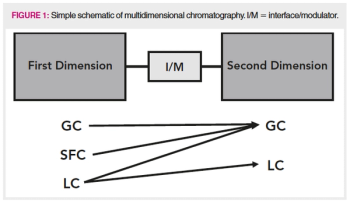
In this instalment of “GC Connections”, the advantages of multidimensional chromatography with HPLC as the first dimension and GC as the second are discussed.

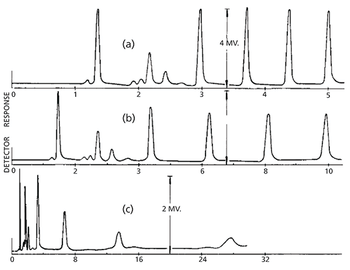
This instalment of “GC Connections” dives into temperature programming. First, the differences in peak widths and retention times between temperature programmed and isothermal chromatograms are examined. Why are all the peaks so sharp in temperature programmed GC, yet they get broader (and shorter) in isothermal GC? Next, we explore some early ideas about temperature programming and peak broadening that explain why the peaks are so sharp in temperature-programmed GC, and why the peak spacing is different from isothermal GC. Finally, we examine an important consequence of our ability to program temperature: the need for temperature programming in splitless and other injections that use “solvent effects” and other peak focusing mechanisms. These points are illustrated using several historical figures and chromatograms from the early days of GC.

Temperature programming is used in most capillary GC separations, but many analysts lack a good understanding of the principles behind this approach.

Two-dimensional gas chromatography (GCxGC) is becoming the technique of choice for analysis of highly complex samples such as petroleum, pharmaceuticals, biological materials, food, flavors, and fragrances. Here, we explain how GCxGC works and provide examples that illustrate its advantages.

This instalment of “GC Connections” begins with a brief introduction to GC×GC, follows with examples of how GC×GC opens additional avenues of analysis, and it concludes with information about how to learn more.

The best troubleshooting is proactive; problems are much more easily prevented then solved. Proactive troubleshooting involves anticipating problems before they start, and stopping them before they disrupt your workflow. It also ensures a long operational lifetime for instruments. Unlike many other instruments, a gas chromatograph (GC) has several components, each of which must be properly maintained and optimized for the full instrument to operate properly. This instalment of “GC Connections” focuses on simple proactive steps that users of a gas chromatograph can take to ensure that instruments will operate correctly over time.

By taking simple proactive troubleshooting steps, GC users can ensure that instruments will operate correctly over time, thus avoiding workflow disruptions.

“The column is the heart of the separation.” Perhaps more accurately, the column is where the chemistry that generates a separation happens. For chemists and non-chemists alike, the chemistry that drives the utility of a column to solve a separation problem can be complex and confusing. Selectivity describes the ability of a column to effect a separation. This instalment of “GC Connections” focuses on selectivity, its definition, and its importance for generating separations and resolution. We will also see how selectivity is the concept that underlies the idea of column polarity. We begin by asking two simple questions about common observations, then extend these observations into a capillary gas chromatography (GC) column, and conclude with an introduction to methods for evaluating the quality, selectivity, and polarity of a stationary phase or column.

Here, we focus on selectivity: its definition, its importance for generating separations and resolution; and its role in column polarity.

While capillary gas chromatography has been undergoing a renaissance, with new columns, detectors, data systems, and multidimensional separations, the classical inlets have remained the same: We are still injecting liquid samples with syringes into split and splitless inlets, as we have for nearly 50 years. Split and splitless injections present several well-known and some not-so-well known challenges, mostly arising from heating of the inlet, that make sample injection and inlets a major hurdle for gas chromatographers. These challenges and some ideas for mitigating them are discussed and a case is made for renewed exploration of the cool inlets and injection techniques: cool on-column and programmed temperature vaporization.

While capillary gas chromatography has been undergoing a renaissance, with new columns, detectors, data systems, and multidimensional separations, the classical inlets have remained the same: We are still injecting liquid samples with syringes into split and splitless inlets, as we have for nearly 50 years. Split and splitless injections present several well-known and some not-so-well known challenges, mostly arising from heating of the inlet, that make sample injection and inlets a major hurdle for gas chromatographers. These challenges and some ideas for mitigating them are discussed and a case is made for renewed exploration of the cool inlets and injection techniques: cool on-column and programmed temperature vaporization.

We discuss the challenges of split and splitless injections, ideas for mitigating them, and the case for renewed exploration of cool inlets and injection techniques.

Three main points summarize the best ways to be successful in gas chromatography (GC): Capillary GC is clean GC; practice, practice, practice; and be a student of GC.

Three main points summarize the best ways to be successful in GC:capillary GC is clean GC; practice, practice, practice; and be a student of GC.

In this article, the combination of SPME with GCxGC and GCxGC–TOF-MS is discussed using mixtures of solvents as example analytes

In this article, the combination of SPME with GC×GC and GC×GC–TOF-MS is discussed using mixtures of solvents as example analytes