Articles by Shimadzu Europa GmbH

This application note presents an automated method for generating calibration curves using an autosampler’s dilution function. It offers practical examples demonstrating a simple setup, enhanced productivity, accuracy and reliability, with a focus on eliminating manual dilution for greater efficiency in HPLC analyses.
Part 2 delves into advanced applications using organic solvents with the HPLC autosampler dilution function. It details procedures for mixed standard solutions, highlighting automation’s role in reducing errors, saving labor and promoting efficient laboratory practices.
GC headspace analysis is commonly used to control volatile organic components in APIs. Methods are specified in U.S. Pharmacopeia General Chapter <467>.
Mesylate and besylate are potentially genotoxic impurities in pharmaceuticals. This app note introduces analysis of sulfonic acid esters utilizing Shimadzu's GCMS-QP.
Nexera Prep with LCMS-2050 and Open Solution software provide a seamless workflow for drug discovery from screening to purification and purity check.
Some nitrosamine compounds are classified as probably carcinogenic to humans. This application note describes the analysis of six nitrosamines by LC–MS/MS.
Shimadzu provides a number of solutions for the analysis of impurities in pharmaceutical products, as described in this Application Notebook.
USP General Chapter <1469> ensures appropriate control of NSAs in drug products. This application replicates NSA determination in APIs using Shimadzu's GCMS-TQ8050 NX.
This application note describes the efficient development of robust analytical methods based on Analytical Quality by Design (AQbD) for small-molecule drugs.
A disadvantage of modern LIBs is instability of the electrolytes. Learn about the use of IC for analysis of decomposition products to evaluate electrolyte degradation.
This work introduces the analysis of iso-α-acids, α-acids, and humulinones in beer in reference to EBC 9.47. IBU was also measured with a UV–vis spectrophotometer.
In this app note, xanthohumol, isoxanthohumol, humulinones, iso-α-acids, α-acids, and β-acids are simultaneously analyzed by high performance liquid chromatography.
This article introduces the high-speed analysis of α-acids and β-acids in hops in reference to EBC 7.7 and ASBC Hops-14.
Volatile sulfur compounds were analyzed in commercially available beer samples using GC with headspace sampler and sulfur chemiluminescence detection.
Shimadzu provides total solutions for beer analysis from farm to stein and service support to keep up with changing market demands.
This application describes the analysis of organic acids in beer by ion-exclusion chromatography and postcolumn pH-buffering conductivity detection.
mAb and ADC aggregate analysis by SEC is introduced. Separation was improved by suppressing secondary interactions using high concentrations of corrosive salts.
This application note covers a non-derivatization LC–MS/MS method for determining total proteinogenic amino acids and taurine amounts in infant/adult milk formulas.
This application note introduces a sensitive simultaneous analysis method for lactose, allolactose, lactulose, and, six other saccharides.
In this application note we used a GCMS-TQ8050 NX to perform SIM and MRM analysis of 3-MCPD, 3-MCPD fatty acid esters, and glycidol fatty acid esters in powdered milk.
This application note covers the use of a method package to assess the safety level of several meat samples, eggs, and milk.
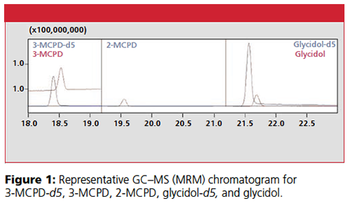
In the present study, a novel GC–MS TQ method was developed and validated for the simultaneous analysis of 2-MCPD, 3-MCPD, and glycidyl fatty acid esters in edible oil. This method was subsequently applied to quantitation of these contaminants in commercial edible oil samples.
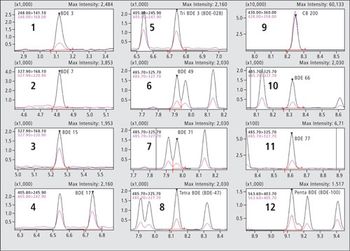
Determination of PBDE congeners can be performed at high sensitivity with good accuracy using the GCMS-TQ8050.

Although pesticides protect crops and plants, they are known to be harmful and of toxicological significance. In order to ensure the safety of the food chain and to protect consumers, fast and reliable methods for the qualification and quantification of residual chemicals, contaminants, and pesticides in food and feed are essential. This article describes the method development and optimization of a fast and simple high performance liquid chromatography-mass spectrometry (HPLC-MS) assay for the separation, qualification, and quantification of common pesticides.