LCGC Europe-03-01-2007

i2-409536-1408660762560.gif

LCGC Europe

Setting realistic expectations requires a good working knowledge of an instrument's capabilities in terms of the sample requirements as well as an understanding of the effects of real-world samples and their matrices on long-term instrument performance.
i4-409538-1408660755073.jpg

LCGC Europe

Research group: Professor Jan Andersson, Institute of Inorganic and Analytical Chemistry, University of Münster, Münster.

i8_t-409539-1408660749948.jpg

LCGC Europe

An overview is presented of possible pathways to enhance peak capacity in liquid chromatography (LC). The peak capacity in a chromatographic separation is directly related to the plate number and thus to column length and particle size. Serial coupled columns can be used to obtain long effective column lengths, reaching over 100000 theoretical plates and peak capacities up to 900. Some theoretical considerations are made on column dimensions and particle size and examples are given of high resolution "GC-like" separations in LC using state-of-the-art LC hardware. Recent developments in LC hardware have also enhanced the applicability of two-dimensional LC–LC and comprehensive LCÃ-LC. Both techniques are extremely powerful to unravel complex samples.

i2-409540-1417779284317.gif

LCGC Europe

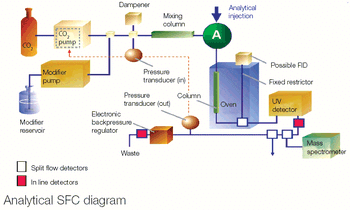
In the mid 1980s the chromatographic application of gases compressed (or liquefied) to supercritical state was tested by research teams from several analytical instrument manufacturers. The recently introduced capillary columns seemed ideal candidates on which to perform such supercritical fluid chromatography (SFC) methods.

i1_t-409537-1408660758487.gif

LCGC Europe

Users need to understand not only the operation of the computer system as required by their access privileges, but also the ethics and integrity required operating under any of the GMP or GLP quality systems.

i1-409534-1408660767978.jpg

LCGC Europe

The 5th HIC/RPC Bioseparation Conference takes place at the Lindner Grand Hotel Beau Rivage Palace, Interlaken, Switzerland from 20–23 March 2007 and is co-ordinated by Tosoh Bioscience GmbH. It is designed to provide a forum for in-depth discussion on industrial downstream processing.