

LCGC North America
After 32 years as a columnist, John Hinshaw writes his final “GC Connections” article, examining how GC has changed over the years and considering where it might go in the future.
LCGC North America
After 32 years as a columnist, John Hinshaw writes his final “GC Connections” article, examining how GC has changed over the years and considering where it might go in the future.

LCGC Europe
I have edited the “GC Connections” column in LCGC for over 32 years. In that time, gas chromatography (GC) has changed from a specialized separations technique to being more routine for standardized methods, while expanding outward to complex multidimensional separations and scaling downward towards miniaturization and portability. In my last “GC Connections” article before stepping away from the role of Editor, I give some perspective on how GC has changed and grown over the years, and where it might go in the future.
LCGC Asia Pacific
Most manufacturers ship gas chromatographs with a small collection of consumable parts and accessories, such as extra ferrules, inlet liners, or septa, and a few instrument-specific tools. In earlier times, some convenience items might have been included as well, like a bubble flow meter or a small set of tools, but now it’s rare to find such things in the shipping boxes. This edition of “GC Connections” lists a number of essential items that should be on hand in every gas chromatography (GC) laboratory, their function, and how to use them effectively.

LCGC North America
Although manufacturers ship gas chromatographs with a collection of consumable parts and accessories, a number of other essential items should be on hand in every GC laboratory. What items are needed and how can they be used most effectively?
LCGC Europe
Most manufacturers ship gas chromatographs with a small collection of consumable parts and accessories, such as extra ferrules, inlet liners, or septa, and a few instrument-specific tools. In earlier times, some convenience items might have been included as well, like a bubble flow meter or a small set of tools, but now it’s rare to find such things in the shipping boxes. This edition of “GC Connections” lists a number of essential items that should be on hand in every gas chromatography (GC) laboratory, their function, and how to use them effectively.
LCGC North America
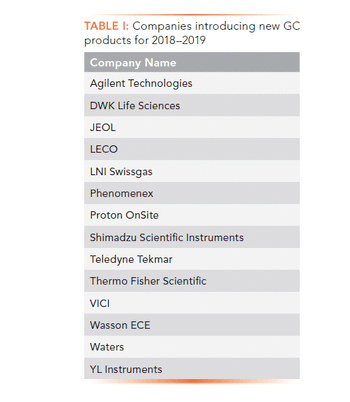
Our annual review of new developments in the field of gas chromatography, as seen at Pittcon and other venues

LCGC Europe
“GC Connections” presents the column’s annual review of new developments in the field of gas chromatography (GC) seen at Pittcon and other venues in the past 12 months.
LCGC North America
The recent relocation of a laboratory yielded a number of insights as to how to ensure a quality environment to deliver quality gas separation and detection within a safe working atmosphere.
LCGC Europe
The quality of a gas chromatogram depends heavily on the quality of the separation and detection gases, among many other factors. In this month’s instalment, “GC Connections” discusses ways in which chromatographers can ensure a safe working environment while delivering gases that are up to the requirements of the separations at hand, in the context of moving a laboratory to a new location.
LCGC North America
We present our annual review of new developments in the field of gas chromatography, which this year includes eight new GC and GC–MS laboratory benchtop systems as well as numerous new columns and accessories.

LCGC Europe
John Hinshaw presents his annual review of new developments in the field of gas chromatography seen at Pittcon and other venues in the past 12 months.
LCGC Asia Pacific
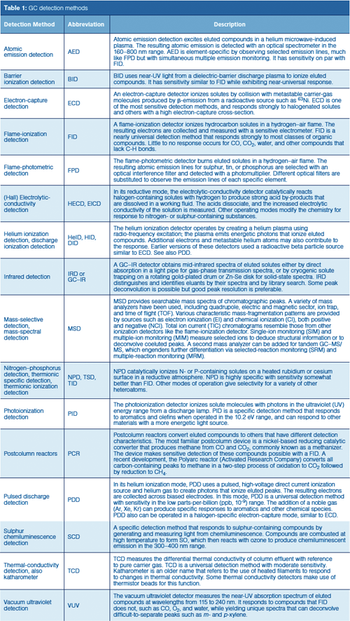
Gas chromatography makes use of a wide variety of detection methods. In addition to the most often used flame-ionization detection (FID), electron-capture detection (ECD), thermal conductivity detection (TCD), and mass-selective detection (MSD), the list of other detection methods is long. They really shine when deployed properly, but their properties and applications can be a bewildering alphabet soup. This instalment presents a compendium of gas chromatography (GC) detection methods, both past and vanished as well as those that are current and relevant to today’s separation challenges.
LCGC North America
Gas chromatography makes use of a wide variety of detection methods, which really shine when deployed properly. Here’s guidance for how to choose the right one for your analysis.
LCGC Europe
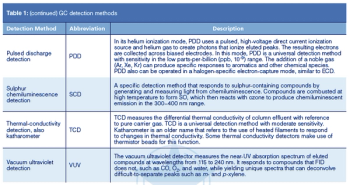
Gas chromatography makes use of a wide variety of detection methods. In addition to the most often used flame-ionization detection (FID), electron-capture detection (ECD), thermal conductivity detection (TCD), and mass-selective detection (MSD), the list of other detection methods is long. They really shine when deployed properly, but their properties and applications can be a bewildering alphabet soup. This instalment presents a compendium of gas chromatography (GC) detection methods, both past and vanished as well as those that are current and relevant to today’s separation challenges.
LCGC Asia Pacific
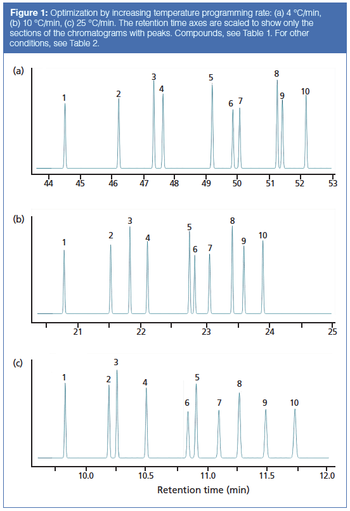
Fast gas chromatography (GC) has received new attention recently in the form of available enhanced instrument capabilities. This instalment reviews important characteristics and requirements of fast GC: What can fast GC do for separations, and how can laboratories take advantage of enhanced separation speeds?
LCGC North America
Fast gas chromatography (GC) has received new attention recently in the form of available enhanced instrument capabilities. What can fast GC do for separations, and how can laboratories take advantage of enhanced separation speeds?

LCGC Europe
In this extended special feature to celebrate the 30th anniversary edition of LCGC Europe, leading figures from the separation science community explore contemporary trends in separation science and identify possible future developments. We asked key opinion leaders in the field to discuss the current state of the art in gas chromatography instruments.
LCGC Europe
Fast gas chromatography (GC) has received new attention recently in the form of available enhanced instrument capabilities. What can fast GC do for separations, and how can laboratories take advantage of enhanced separation speeds?
LCGC Asia Pacific
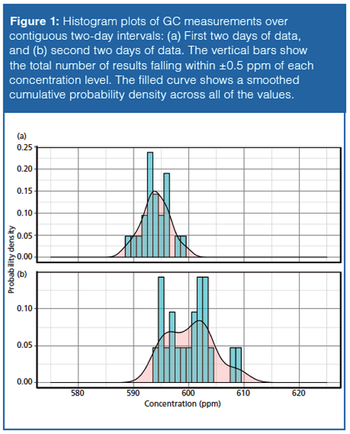
Small differences in process gas chromatography (GC) results from the same sample stream over time can indicate corresponding changes in target analyte concentrations, or the fluctuations might be due to external influences on the instrument. This instalment of ”GC Connections” explores ways to examine such results and better understand their significance.
LCGC North America
When data change over time, you may be able to tease out the causes by conducting a time-series analysis or by looking at various forms of correlation.

LCGC North America
If you understand how your system is affected by outside influences, you can take control of the variables.

LCGC Europe
Small differences in process gas chromatography (GC) results from the same sample stream over time can indicate corresponding changes in target analyte concentrations, or the fluctuations might be due to external influences on the instrument. This instalment of ”GC Connections” explores ways to examine such results and better understand their significance.
LCGC Asia Pacific
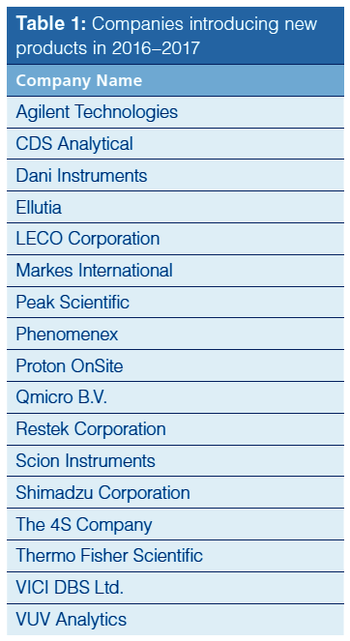
In this instalment, John Hinshaw presents an annual review of new developments in the field of gas chromatography (GC) seen at Pittcon 2017 and other venues in the past year.
LCGC North America
Annual review of new developments in the field of GC
LCGC Europe
In this instalment, John Hinshaw presents an annual review of new developments in the field of gas chromatography (GC) seen at Pittcon 2017 and other venues in the past year.
LCGC North America
Gas chromatographers can control several variables that affect their separations: carrier-gas flow, column temperature, column dimensions, and stationary phase chemistry. When faced with less than optimum resolution or separation speed, a strategy of changing just one variable at a time can be more productive than trying to hit the goal in one attempt. This month's GC Connections examines how to use such a plan to obtain better GC results.

LCGC Europe
Gas chromatographers can control several variables that affect their separations: carrier-gas flow, column temperature, column dimensions, and stationary-phase chemistry. When faced with less than optimum resolution or separation speed, a strategy of changing just one variable at a time can be more productive than trying to hit the goal in one attempt. This month’s “GC Connections” examines how to use such a plan to obtain better gas chromatography results.

LCGC Europe
Separation scientists may seek an optimum spot between chromatographic performance required to obtain sufficient results quality, and the time and resources needed to do so. This instalment of “GC Connections” examines the factors that control peak resolution - one of the main drivers of separation quality - and how chromatographers can use this information to find an optimum between time, cost, and performance.
LCGC North America
Separation scientists may seek an optimum spot between chromatographic performance required to obtain sufficient results quality, and the time and resources needed to do so. This installment of GC Connections examines the factors that control peak resolution - one of the main drivers of separation quality - and how chromatographers can use this to find an optimum between time, cost, and performance.
LCGC North America
This month's “GC Connections” continues the discussion of procedures for safe setup, use, and disposal of compressed gas cylinders in the chromatographic lab.

March 1st 2013

January 1st 2013
January 1st 2013
March 1st 2013
November 1st 2000
March 1st 2002