LCGC Europe-12-01-2016

wine.jpg

LCGC Europe

This article describes a workflow for the analysis of phenolic components in wine enabling confident differential analysis using high performance liquid chromatography (HPLC) in combination with low-field drift-tube ion mobility quadrupole time-of-flight mass spectrometry (IMS-QTOF-MS).

Krystek.jpg

LCGC Europe

The evaluation of the oral uptake of engineered nanoparticles (ENPs) contained in personal care products like mouthwashes is of great relevance to estimate the potential hazards and the toxicity of engineered nanomaterials (ENMs). Various experiments were performed while two commercially available mouthwash products (named M1 and M2) were selected as samples of interest. Asymmetric flow field‑flow fractionation (AF4) was chosen and optimized as the particle separation technique and two detectors were on-line coupled while dynamic light scattering (DLS) was used for evaluation and signals obtained by ultraviolet–visible (UV–vis) detection at 254 nm were used to gather additional information about the fate of the ENPs.

Bartle, Adlard.jpg

LCGC Europe

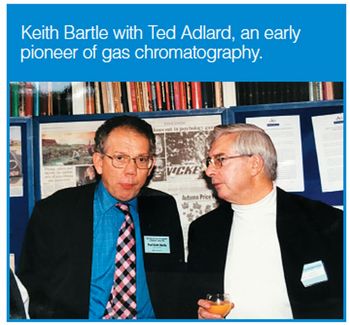
Keith Bartle, Emeritus Professor of Physical Chemistry and Visiting Professor in the Energy Centre of the University of Leeds, UK, has been a creative catalyst in a wide range of chromatographic collaborations stretching from the analysis of methane in air to printing inks. He spoke to Caroline West from the University of Orléans, in Orléans, France, about his career in chromatography and his proudest scientific achievements in separation science, including his research in supercritical fluid chromatography (SFC), gas chromatography (GC), and “the unified chromatograph”.

figure 1.jpg

LCGC Europe

Interest in chromatography using hydrophilic interaction liquid chromatography (HILIC) has continued to build in recent years. Adoption of the technique has been slowed by experiences of poor reproducibility. In particular, reequilibration times in HILIC have been reported as being exceptionally long as compared to reversed-phase chromatography. In this study, reequilibration times in HILIC for both aqueous–organic gradients and buffer gradients are systematically explored. The results not only promise to improve method development practices, but also provide insight into HILIC retention mechanisms across mechanistically differing polar stationary phases.
