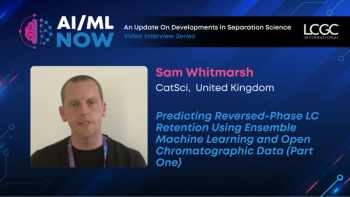
Sam Whitmarsh describes a practical workflow for predicting reversed-phase LC retention times using ensemble machine learning and open chromatographic data.
Sam Whitmarsh explores how retention-time models handle interlaboratory data, novel chemotypes, unusual phases and ionisable compounds, and what labs need to do to build useful in-house models.
Predicting retention time is one of the hardest parts of reversed-phase LC method development, and often involves repeated scouting runs, trial and error, and extensive time on the instrument. In this video interview conducted at HTC-19 in Leuven, Belgium Sam Whitmarsh from CatSci, UK talks about his presentation “Predicting Reversed-Phase LC Retention Using Ensemble Machine Learning and Open Chromatographic Data”. The ensemble model combines molecular descriptors, column characterisation and gradient information, and its predictions come close to the limits of experimental reproducibility. In this short video interview,he explains how the model was built, what drives its accuracy, and where it could be improved in real pharmaceutical workflows.
Whitmarsh answered the following questions:
Watch the full video here:
View part one here:
Reference
“Predicting Reversed-Phase LC Retention Using Ensemble Machine Learning and Open Chromatographic Data”. Presentation at HTC-19 conference, held from May 26–29, 2026, in Leuven, Belgium.