

News|Videos|November 9, 2026 (Updated: November 8, 2027)
AI/ML Now: Keeping Elution Order Intact During LC Method Transfer
Author(s)Sebastian Böcker, Alasdair Matheson
Sebastian Böcker discusses taking retention prediction beyond reversed-phase to HILIC, what changes elution order in method transfer, and sharing data via RepoRT.
Advertisement
Retention times are useful for identifying small molecules in LC–MS, but they are notoriously hard to predict across laboratories. Even small changes in column, mobile phase, pH or instrument plumbing can shift them. Most existing models must be trained on data from the same system they will later predict for.
In this second episode of AI/ML Now, Sebastien Böcker discusses the group’s recent Nature Methods paper: “Times Are Changing but Order Matters: Transferable Prediction of Small-Molecule Liquid Chromatography Retention Times.1 This research introduces “2-step,” a machine learning approach that splits the problem in two. A graph neural network first predicts a retention order index from a compound’s structure and the column and mobile-phase conditions. A small set of anchor compounds then converts that index into retention times on the user’s own system. No model retraining is needed, and the method outperforms approaches that were trained on the target system, according to Böcker.
In this episode Sebastian Böcker answers the following questions:
• Which chromatographic variables cause the biggest changes in retention order, and what should chromatographers watch for when transferring methods?
• How far can the model be pushed beyond standard reversed-phase conditions, for example to hydrophilic interaction liquid chromatography (HILIC)?
• How should laboratories integrate predicted retention times into routine LC–MS annotation workflows, and what data could they contribute to RepoRT to improve the model?
Watch the second part of the interview here:
Watch the first episode here:
AI/ML Now: Rethinking Retention Time Prediction using Machine Learning
Reference
1. Kretschmer, F.; Harrieder, E.-M.; Witting, M.; Böcker, S. Times Are Changing but Order Matters: Transferable Prediction of Small-Molecule Liquid Chromatography Retention Times. Nat. Methods 2026. DOI: 10.1038/s41592-026-03243-2.
Advertisement
Related to this article
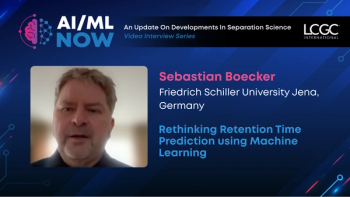
Sebastian Böcker discusses how predicting retention order, not time, makes liquid chromatography retention time prediction transferable across laboratories.
How feasible is it to integrate this Bayesian graph-theory methodology into existing commercial chromatography software workflows for semi-automated data curation in routine analytical laboratories?
Gabriel Vivó-Truyols outlines the benefits and challenges of combining graph theory with Bayesian statistics to automate peak assignment and alignment.
Gabriel Vivó-Truyols from the Spanish Council for Scientific Research, Madrid, Spain. discusses his work on using graph theory and Bayesian statistics for peak assignment and chromatographic alignment.
Leon Niezen and Gert Desmet discuss uncertainty-driven LC method development, peak overlap, and moving from in silico to real data.
Leon Niezen and Gert Desmet describe how predictive uncertainty can make automated LC method development more reliable.
Sam Whitmarsh explores how retention-time models handle interlaboratory data, novel chemotypes, unusual phases and ionisable compounds, and what labs need to do to build useful in-house models.
Advertisement
Advertisement