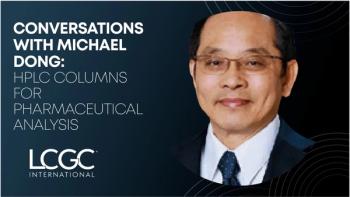
In Part 2 of "Conversations with Michael Dong," the LCGC column editor discusses HPLC columns for pharmaceutical analysis and the case for short columns.
The concept of theoretical plates is one of the most important ways to measure column efficiency in chromatography, and both practitioners and theorists return to it as the foundation for understanding separation performance. As described in Howard G. Barth’s
The origins of this concept can be traced back to fractional distillation, but its adaptation to chromatography by A. J. P. Martin and R. L. M. Synge in the 1940s was transformative. Their work, which eventually earned the Nobel Prize in Chemistry in 1952, provided the theoretical underpinning for partition chromatography and for modern separation science as a whole. Barth’s article emphasizes how this once abstract model became the working language of chromatographers, shaping how efficiency is described, measured, and compared.
In practical terms, the number of theoretical plates is directly related to peak sharpness and separation quality. High plate numbers signal efficient columns capable of producing narrow, well-resolved peaks, while low plate numbers are associated with broad, overlapping peaks and poor resolution. Closely linked to this measure is plate height, which normalizes efficiency relative to column length and allows for meaningful comparisons across different systems. Smaller plate heights indicate greater efficiency per unit length, a valuable tool when selecting and evaluating columns.
Barth also stresses the applied value of plate counts. They serve as a diagnostic tool for validating new columns, optimizing parameters such as flow rate, and monitoring column health over time. A declining plate count is often the earliest signal of column degradation, functioning like a warning light that alerts the scientist before resolution is compromised.
Ultimately, as Barth highlights, theoretical plates remain central to chromatography because they bridge elegant theory with day-to-day laboratory practice, providing a simple yet powerful framework for achieving reliable separations.
This video was created using NotebookLM and Gamma.