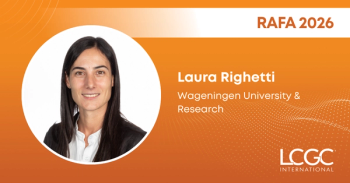
Laura Righetti explains why quantification, not instrumentation, still keeps mass spectrometry imaging (MSI) out of routine food safety testing.
In this interview recorded at analytica 2026 in Munich, Giorgia Purcaro discusses how GC‑based hyphenated techniques are reshaping the analysis of complex food samples.
At analytica 2026 in Munich, Germany, LCGC International interviewed Giorgia Purcaro from the University of Liège on her presentation, “GC-Based hyphenated techniques for detailed characterization of complex samples.”1
In this video clip, Purcaro answers the following questions:
The field of food analysis is undergoing a significant transformation, moving away from single-parameter methods toward integrated analytical strategies capable of capturing the true complexity of real-world samples.2 This shift demands solutions that combine high selectivity, sensitivity, and information richness, while remaining practical for both routine laboratory use and industrial-scale workflows. GC-based hyphenated chromatographic techniques have emerged as particularly powerful tools in this context, enabling the detailed characterization of complex food matrices with unprecedented resolution.
Configurations including heart-cutting gas chromatography (GC–GC), comprehensive two-dimensional gas chromatography (GC×GC), and liquid chromatography (LC)–GC(×GC) couplings offer a versatile analytical platform capable of supporting both targeted and untargeted profiling within a single run. These techniques deliver enhanced separation power alongside chemically meaningful fingerprints, making them well-suited for the reliable assessment of food quality, authenticity, and safety across a wide range of sample types.
In her presentation, Purcaro explored the practical advantages of GC-based hyphenated techniques through a series of carefully selected case studies drawn from real analytical challenges in the food sector. The ability of GC×GC to generate information-rich chromatographic fingerprints were demonstrated, highlighting how this approach unlocks deeper chemical insight from complex matrices. The role of GC×GC in streamlining and simplifying sample preparation procedures was also examined, illustrating the synergistic benefits of integrating separation power at multiple stages of analysis. Finally, the combination of pre-fractionation by LC with GC and GC×GC were explored in the context of food contaminant analysis, with a particular focus on mineral oil hydrocarbons—a growing area of regulatory and public health concern.
Giorgia Purcaro is full professor of analytical chemistry at the Gembloux Agro-Bio Tech Department of the University of Liège, Belgium. Her research focuses on the development and miniaturization of sample preparation methods coupled with hyphenated chromatographic techniques—principally LC–GC and GC×GC—with applications centred on food contaminants and quality assessment. She is the author of over 140 peer-reviewed publications, 12 book chapters, and more than 200 conference presentations. Her contributions to the field have been recognized with the prestigious Leslie Ettre Award for outstanding contributions to capillary chromatography, and the J. Phillips Award for her work advancing GCxGC.