
News|Videos|July 1, 2026
How HILIC Works for Oligonucleotide Analysis: Challenges and Misconceptions
Author(s)Jonathan Maurer, Alasdair Matheson
Key Takeaways
- Current HILIC retention concepts insufficiently explain oligonucleotide behavior on amide phases, limiting predictability and complicating analytical optimization for closely related therapeutic species.
- Dominant retention arises from hydrogen bonding and solvophobic effects, while ionic and dipole interactions are secondary and hydrophilic partitioning is typically a minor contributor.
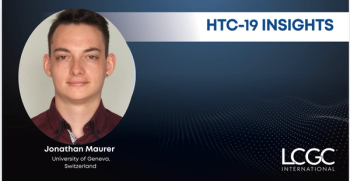
Jonathan Maurer from the University of Geneva, Switzerland describes some of the challenges and misconceptions surrounding hydrophilic interaction chromatography (HILIC) and oligonucleotide analysis.
Advertisement
At HTC-19 in Leuven, Belgium, LCGC International spoke to Jonathan Maurer from the University of Geneva, Switzerland about his presentation ‘How HILIC Works for Oligo Analysis”.1,2
In this episode, Jonathan answered the following questions
• What analytical challenges in oligonucleotide characterization are not adequately addressed by current HILIC retention models?
• Why does misunderstanding the retention mechanism in HILIC make method development for biopharmaceutical analysts more difficult and less predictable?
• How does identifying solvophobic effects and hydrogen bonding as dominant retention drivers improve the robustness of oligonucleotide separations?
Hydrophilic interaction chromatography (HILIC) is widely used for the analysis of therapeutic oligonucleotides because it offers high separation efficiency and compatibility with mass spectrometry (MS). However, method development is often limited by an incomplete understanding of the mechanisms responsible for analyte retention.
In his presentation, Jonathan Maurer described the relative importance of hydrogen bonding, ionic interactions, dipole interactions, and solvophobic effects in oligonucleotide retention on amide HILIC stationary phases. His findings demonstrated that hydrogen bonding and solvophobic interactions are the primary drivers of retention, whereas hydrophilic partitioning has only a limited contribution under typical analytical conditions. He also described how incorporating protic solvents into the mobile phase can improve selectivity and facilitate the separation of closely related oligonucleotide species.
These insights provide a revised mechanistic framework for HILIC separations, offering a more predictive approach to developing robust analytical methods for nucleic acid therapeutic,
References
1. Maurer J. How HILIC Works For Oligo Analysis. Presented at HTC-19 2026, in Leuven, Belgium.
2.Maurer, J.; Addepalli, B.; Gritti, F.; Lauber, M. A.; Guillarme, D.; Fekete, S. Retention Modeling of Oligonucleotides on an Amide-Based HILIC Column: A Descriptor-Driven Approach. J. Chromatogr. A2026, 467001. DOI:
Biography
Jonathan Maurer is a post-doctoral researcher at the Institute of Pharmaceutical Sciences of Western Switzerland (ISPSO), University of Geneva, working in the group led by Prof Davy Guillarme. His research focuses on developing advanced chromatographic methods for characterizing nucleic acid-based drug products in collaboration with Sanofi's mRNA Center of Excellence. He completed his Ph.D. at the University of Lausanne, where he specialized in mass spectrometry quantification of endogenous peptides and their clinical relevance. Jonathan has authored 15+ publications in high-impact journals (h-index 8), presented at international conferences, and received over CHF 125,000 in research funding. He is actively involved in scientific communities, serving as a board member of the ccCTA, as the founder and president of its Young Scientists’ Club, and as a regular reviewer for leading journals. Passionate about analytical chemistry and innovation, his work bridges academia and industry to advance pharmaceutical science.
Advertisement
Related Content
Advertisement

Advertisement
Advertisement