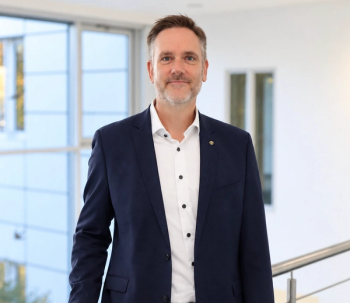
Florian Geistmann succeeded retiring Jürgen Semmler as Shimadzu Europa managing director on October 1.
One of the hallmarks of Analytica is its scientific program, which features a range of speakers from varying backgrounds. The talks that are delivered at Analytica touch upon some of the most important trends in chromatography, detailing how chromatographic techniques are being used in various application areas, including environmental analysis, pharmaceuticals, engineering, and biological analysis, to name a few.
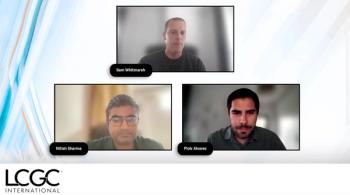
In the video below, four of the speakers at Analytica provide a brief overview of the talks they gave at the conference (1–4). The four speakers featured in this video include:
Gilar’s talk was titled, “RNA Analysis with LC and Affinity LC Methods” (1). He highlighted advances in mass spectrometry for RNA analysis, particularly a new method using novel RNase enzymes to generate optimal-length fragments for liquid chromatography–mass spectrometry (LC–MS). He also discussed challenges with denaturing and non-denaturing conditions and introduced a technique for measuring RNA melting temperature (Tm) to guide analytical choices (1).
Grinias’s talk was titled, “Greener and Faster Separations with Capillary Liquid Chromatography” (2). Grinias emphasized how capillary liquid chromatography offers greener and faster separations by reducing solvent use, waste, and energy consumption while maintaining analytical quality (2).
Hamid’s talk was titled, “Strain-Level Differentiation of Microorganisms using High-Resolution Ion Mobility Mass Spectrometry” (3). Hamid explained how integrating ambient ionization, liquid chromatography, and high-resolution ion mobility tandem mass spectrometry enables precise microbial characterization down to the species and strain levels with high predictive accuracy (3).
Cody’s talk was titled, “Snapshots to Separations: From Ambient Ionization Mass Spectrometry to GCxGC-HRMS with a Giant Searchable Database” (4). His talk discussed the applicability of ambient ionization mass spectrometry (AI-MS) to solve specific analytical challenges (4).
This video is part of our coverage of the Analytica USA conference. To stay up to date on all our recent coverage of Analytica, click