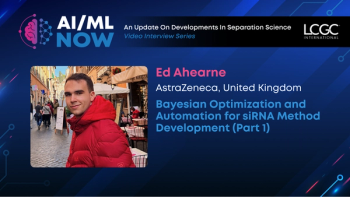
Ed Ahearne highlights the benefits of ML-driven chromatography for the development of biopharmaceutical products
Tony Edge explains how SPE optimization improves oligonucleotide LC–MS data.
Oligonucleotide therapeutics have moved from niche research tools to an established and fast-growing class of medicines. Antisense oligonucleotides, siRNAs, and aptamers are now progressing through clinical pipelines and onto the market. As they advance, demand is rising for robust bioanalytical methods that can quantify them accurately in plasma, serum, tissue, and other complex biological matrices. These molecules are difficult to analyze. Their high polarity and multiple negative charges, together with their tendency to bind to proteins and surfaces, make them hard to isolate cleanly. Endogenous matrix components can also suppress ionization and compromise detection.
Solid-phase extraction (SPE) has become one of the most promising ways to meet these challenges, but its success depends on careful method development. In this interview, Tony Edge discusses the biggest obstacles to extracting oligonucleotides from biological samples and explains which of them a well-designed SPE approach addresses most effectively. He describes the parameters that had the greatest influence on recovery and reproducibility during optimization, and he considers how the choice of sorbent affects the recovery of oligonucleotides of different types and lengths. Finally, he looks at the often-underestimated role of sample preparation in liquid chromatography–mass spectrometry (LC–MS) workflows, and at how much the quality of mass spectrometric data depends on what happens before a sample reaches the instrument.
Edge has worked across the separation science landscape for decades. He is currently President of the UK Chromatography Society, where he supports the next generation of scientists. He has held roles at AstraZeneca, LGC, Thermo Fisher Scientific, and Agilent Technologies, and he led the development of next-generation HPLC stationary phases as R&D Manager at Avantor. Most recently, he worked as a business analyst at TetraScience, focusing on AI-native laboratory data. In 2008 he was awarded the Desty Memorial Lecture and received a clinical excellence award from AstraZeneca. He also serves on the permanent scientific committee of the International Symposium on Chromatography.