Agilent Technologies, Inc.
Articles by Agilent Technologies, Inc.

Data integrity problems in pharmaceutical quality control laboratories are driving more regulatory action than ever before. It is obvious that something has changed to drive all this activity. There is plenty of information available, but much of it seems to confuse or frustrate rather than clarify or help. In this summary, we will provide clarity, dispelling confusion by looking at the facts, based on a study of available resources and direct interactions with FDA staff and their consultants. You’ll learn from Loren Smith, Agilent’s software compliance expert and a UC Berkeley instructor with 25 years of regulated software experience, how to put the current enforcement environment in historical context, and to apply critical thinking skills to what you hear or read regarding data integrity. You’ll also learn how to evaluate your current laboratory software and associated processes against these new expectations, as well as how vendors are redesigning laboratory software to help you respond to these new realities.
Data integrity problems in pharmaceutical quality control laboratories are driving more regulatory action than ever before. It is obvious that something has changed to drive all this activity. There is plenty of information available, but much of it seems to confuse or frustrate rather than clarify or help. In this summary, we will provide clarity, dispelling confusion by looking at the facts, based on a study of available resources and direct interactions with FDA staff and their consultants. You’ll learn from Loren Smith, Agilent’s software compliance expert and a UC Berkeley instructor with 25 years of regulated software experience, how to put the current enforcement environment in historical context, and to apply critical thinking skills to what you hear or read regarding data integrity. You’ll also learn how to evaluate your current laboratory software and associated processes against these new expectations, as well as how vendors are redesigning laboratory software to help you respond to these new realities.
WAX type columns are the industry standard analyzing a wide range of compounds with polar functional groups. The new Agilent DB-WAX Ultra Inert GC column is presented.
WAX type columns are the industry standard analyzing a wide range of compounds with polar functional groups. The new Agilent DB-WAX Ultra Inert GC column is presented.
Reduce dissolution qualification time and improve visibility to instrument performance – see how current regulations combined with updated technology can redefine your dissolution environment!
Data integrity problems in pharmaceutical quality control laboratories are driving more regulatory action than ever before. It is obvious that something has changed to drive all this activity. There is plenty of information available, but much of it seems to confuse or frustrate rather than clarify or help. In this whitepaper, we will provide clarity, dispelling confusion by looking at the facts, based on a study of available resources and direct interactions with FDA staff and their consultants. You’ll learn from Loren Smith, Agilent’s software compliance expert and a UC Berkeley instructor with 25 years of regulated software experience, how to put the current enforcement environment in historical context, and to apply critical thinking skills to what you hear or read regarding data integrity. You’ll also learn how to evaluate your current laboratory software and associated processes against these new expectations, as well as how vendors are redesigning laboratory software to help you respond to these new realities.
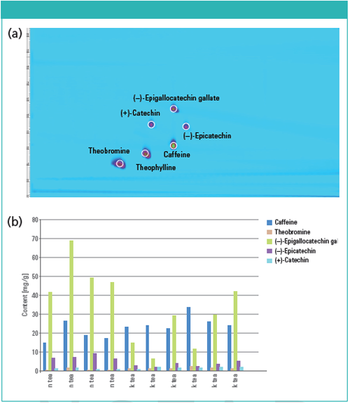
This application note discusses the comprehensive 2D‑LC analysis of green and black tea. The purine alkaloids caffeine and theobromine, as well as the catechins catechin, epicatechin, and epigallocatechin gallate, are quantified.

Comprehensive 2D-LC enables the analysis and quantification of purine alkaloids and catechins in green and black tea. As expected, green tea contained higher amounts of the catechins epigallocatechin gallate and epicatechin than black tea.

enable authentication of Si-Wu-Tang, a separate comprehensive 2D-LC analysis of each herb contained in Si-Wu-Tang was performed.

This application note demonstrates the comprehensive 2D-LC analysis of different types of beer. Nontargeted, multisample analysis (fingerprinting analysis) enabled a classification of the different types of beer analyzed.

The Agilent 1200 Infinity Series HDR-DAD Impurity Analyzer System covers a wide linear range typically up to 6000 mAU and enables the analysis of impurities typically down to 0.2 mAU.

In this application we demonstrate the analysis of coffee and coffee products according to DIN methods. The performance of the analysis is shown for linearity, limit of detection (LOD), limit of quantification (LOQ), retention time, and area precision.

This application demonstrates that stringent sensitivity requirements for the detection of potentially harmful primary aromatic amines can be fulfilled when using an Agilent 1290 Infinity LC system equipped with the 1290 large volume injection kit.

Ion exchange is a perfect technique for analyzing large biomolecules such as proteins, peptides and oligonucleotides. These complex compounds contain numerous components (amino acids, nucleotides, glycans etc.) many of which possess a charged side chain or backbone.

Beta blockers can be abused in sports involving little physical activity, such as archery, to reduce cardiac contraction, heart rate, and coronary blood flow.
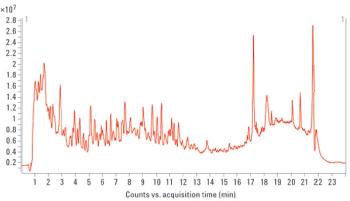
Wine is a beverage produced and consumed throughout the world and is a highly valued commodity. Its classification and authenticity can be very important.
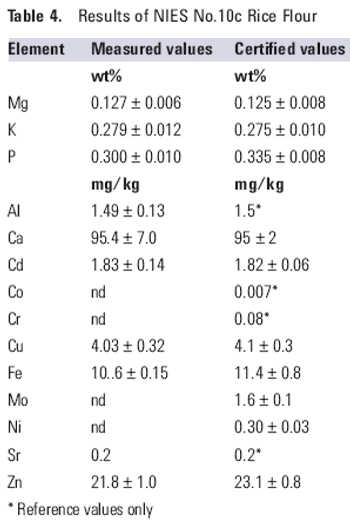
Whether the goal is food safety, ensuring quality or establishing provenance, measuring the trace element content of foods and beverages that we all consume is of paramount importance.

More than 1000 pesticides are currently used worldwide in the treatment of soil and crops. Many countries have established allowable levels of those pesticides in food to protect consumers. While these maximum residue levels (MRLs) vary, the default tolerance is 10 parts per billion (ppb).

Erythropoietin protein (EPO) is a glycoprotein hormone found in plasma. It is a cytokine for erythrocyte (red blood cell) precursors in the bone marrow.
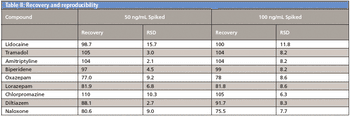
Determination of pharmaceuticals in biological matrices is commonly employed in ADME (DMPK), clinical, and forensic analysis. The main techniques used for drug monitoring and analysis are immunoassays, LC, and GC methods.
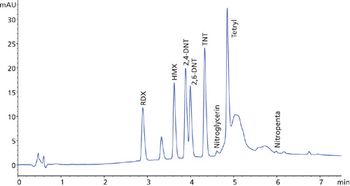
This application note describes the method for detection of nanogram levels of explosive constituents in seawater samples (e.g., after detonation of unexploded ordnance devices). The improved chromatographic method was developed using the Agilent 1290 Infinity LC Method Development system.
An Agilent ZORBAX Rapid Resolution HT Eclipse Plus Phenyl-Hexyl column resolved many compounds from Stevia rebaudiana Bertoni plant extracts using an isocratic reversed phase method with UV and MS detection instead of a typical approach employing an amino column with a refractive index or other special detector. The Eclipse Plus Phenyl-Hexyl method's advantages include high peak capacity, isocratic mobile phase, low acetonitrile consumption, and MS compatibility.
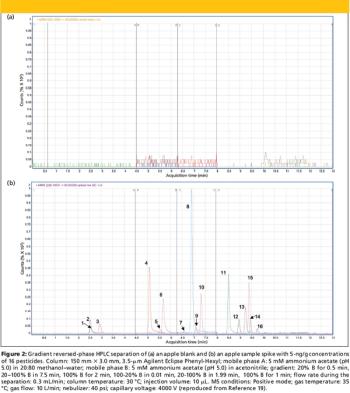
Based on the QuEChERS AOAC Official Method 2007.01, sixteen pesticides were used for evaluating the performance of the Agilent's AOAC Buffered Extraction and SampliQ QuEChERS Dispersive SPE kits for General Fruits and Vegetables. Apple was selected as the fruit matrix. The pesticides are from the "representative pesticides" list (1). A method working well for these representative pesticides should work equally well for the other pesticides that are routinely monitored in multi-class, multi-residue methods. The compounds are from nine different pesticide classes: including acidic, basic, neutral, base-sensitive, and acid-labile pesticides. The selected pesticides are suitable for LC–MS-MS analysis. The MRLs of these pesticides have been set at 10 ng/g or higher (2–4).
