Agilent Technologies, Inc.
Articles by Agilent Technologies, Inc.

This webcast will dive into the complexity of cannabis pesticides analysis and detail analytical workflows developed to help you meet the current regulatory requirements set by the State of California. Ron Honnold and Pete Stone will share their expertise on one of the most complex matrices and how to overcome the challenges.
Live: Friday, Apr. 26, 2019 at 11am EDT | 8am PDT | 4pm BST | 5pm CEST / On Demand: available after airing until Apr. 26, 2020.
Register free: http://www.chromatographyonline.com/lcgc/regulations
Do you have questions about how to ensure data integrity? Then tune into this podcast series from LCGC. In this episode, hear from data integrity and quality systems expert Mark Newton about the shifting focus in data integrity, common problems and questions, and what you need to think about as you address data integrity in your company, or as you update software.
Do you have questions about how to ensure data integrity? Then tune into this podcast series from LCGC. In this episode, hear from data integrity and quality systems expert Mark Newton about dealing with data integrity issues arise in connection with sampling, sample preparation, aborted chromatographic runs, chromatographic integration, hybrid models, and more.
Do you have questions about how to ensure data integrity? Then tune into this podcast series from LCGC. In this episode, hear from data integrity and quality systems expert Mark Newton about the role of second-person review, the four Cs, training, oversight, and preparing for the future.
Learn the importance and impacts of PFAS in water treatment plants
Live:
Europe: Thursday, Jan. 24, 2019 at 2pm GMT | 3pm CET
North America: Thursday, Jan. 24, 2019 at 2pm EST |1pm CST |11am PST
Asia Pacific: Friday, Jan. 25, 2019 at 8:30am IST | 11am CST | 12pm JST
On Demand: available after airing until Jan. 25, 2020.
Register free: http://www.chromatographyonline.com/lcgc_w/treatment
Sensitive detection of more than 250 pesticide residues in foods using the Agilent Ultivo Triple Quadrupole LC/MS system
Sensitive detection of more than 250 pesticide residues in foods using the Agilent Ultivo Triple Quadrupole LC/MS system
The advantage of UV spectroscopy as an analytical method to detect protein aggregation is that it is non-destructive and uses low sample volumes, minimal sample preparation requirement and easy sample analysis. A quick QC method to indicate the presence of aggregation uses an Agilent Cary 60 UV-Vis spectrophotometer to identify aggregation of mAb solutions resulting from different stress conditions.
The Agilent 1290 Infinity II UHPLC, an Agilent 6545 Q-TOF-MS, and Agilent MassHunter BioConfirm B.08.00 software was used for accurate disulphide bond mapping.
With the evolving market and demand for matrix-optimized transitions, the Agilent P&EP 4.0 Analyzer includes the addition of 7,800 matrix-optimized transitions to provide customers with their optimal pesticides analysis.
195 pesticides were chosen to evaluate both the traditional time segment (TS) acquisition and dMRM acquisition structures. The use of dMRM provides the capability to better tackle large multi-analyte analysis.
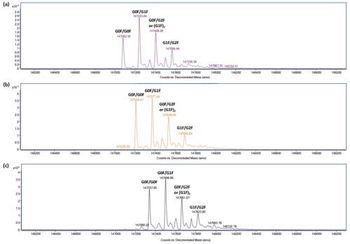
This application note demonstrates the analysis of charge variants of Rituximab (both innovator and biosimilar molecules) using multiple heart-cutting two-dimensional liquid chromatography (2D-LC) with mass spectrometry (MS) detection.
Analysis of additives such as sweeteners, preservatives, and caffeine in various food products, beverages, and consumer toothpaste using the Agilent 1290 Infinity II LC.
Analysis of additives such as sweeteners, preservatives, and caffeine in various food products, beverages, and consumer toothpaste using the Agilent 1290 Infinity II LC.
In this application the Agilent 1290 Infinity II LC was used to determine the bitter compounds iso-alpha-acids and reduced iso-alpha-acids, and the clove-like phenolic flavor 4-vinylguaiacol in bottled beer.
In this application the Agilent 1290 Infinity II LC was used to determine the bitter compounds iso-alpha-acids and reduced iso-alpha-acids, and the clove-like phenolic flavor 4-vinylguaiacol in bottled beer.
This application note describes a UHPLC/MS/MS-based method for the screening and quantification of more than 250 pesticides and pesticide metabolites in food samples.
This application note describes a UHPLC/MS/MS-based method for the screening and quantification of more than 250 pesticides and pesticide metabolites in food samples.
This new e-book considers what functions and features should be available in an ideal chromatography data system (CDS) for use in a regulated analytical laboratory.
This Application Note describes the method transfer of a USP HPLC method for amlodipine besylate tablets to a UHPLC method using the Agilent 1290 Infinity II LC.
This Application Note describes the method transfer of a USP HPLC method for amlodipine besylate tablets to a UHPLC method using the Agilent 1290 Infinity II LC.

