
The Application Notebook
Anthocyanins are a sub-class of naturally electron deficient and powerful antioxidants called flavonoids that are responsible for the red, orange, and blue coloration in fruits and flowers.
Dionex Corporation
The Application Notebook
Anthocyanins are a sub-class of naturally electron deficient and powerful antioxidants called flavonoids that are responsible for the red, orange, and blue coloration in fruits and flowers.
The Application Notebook
Tea, one of the most consumed non-alcoholic drinks worldwide, contains catechins that are powerful antioxidants thought to provide many health benefits, including reduction of cholesterol and obesity, and protection against cardiovascular disease and cancer.
The Application Notebook
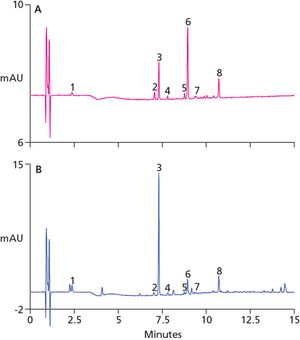
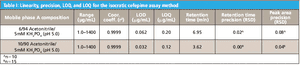
Development of cephalosporin antibiotics has led to compounds with a broad spectrum of activity against both Gram-positive and Gram-negative bacteria with low toxicity profiles. Cefepime, a fourth-generation cephalosporin, is a commonly prescribed broad spectrum antibiotic with improved activity against Gram-negative bacteria compared to other commercially available cephalosporins (1). Despite extensive research on this class of drugs, quantitative analysis and purity assays remain problematic (2).
The Application Notebook
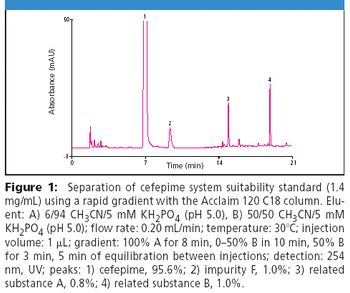
Cephalosporins contain a four-member β-lactam ring that is inherently strained and prone to hydrolysis and photolysis, limiting stability and leading to degradation products that may be toxic (1). In addition, synthetic byproducts are generated and persist during production of these antibiotics including cefepime. Analysis of cefepime purity is particularly challenging due to the presence of such isomeric synthetic impurities. The Acclaim® 120 C18, 3 μm can be used to meet and exceed the criteria set by the USP for determining related substances and assaying the purity of cefepime.

LCGC Asia Pacific
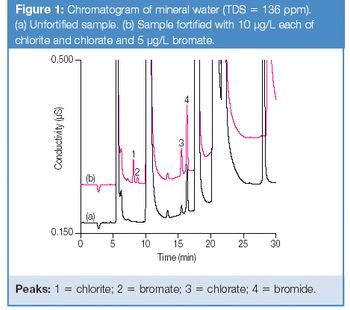
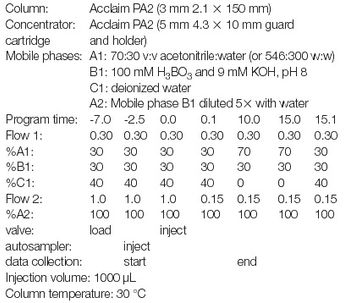
Suppressed conductivity detection is a well-developed method for detecting charged species. Reversed-phase high-performance liquid chromatography (RP-HPLC) is a well developed method of separating substances on the basis of hydrophobicity. There are some situations where it is advantageous to use these two methods together. Perfluoro-acids (PFOAs) are one class of compounds that are ionic, hydrophobic and have low UV absorbance and are, therefore, suited to this combination.
LCGC Asia Pacific
Brian De Borba and Jeffrey S. Rohrer, Dionex Corporation

LCGC Asia Pacific
Brian De Borba and Jeffrey S. Rohrer, Dionex Corporation
June 1st 2011
February 1st 2009


