

We explain several of the more frequent causes of bad peak shapes in liquid chromatography and provide tips on how to remedy them.

Dwight R. Stoll is the editor of “LC Troubleshooting”. Stoll is a professor and the co-chair of chemistry at Gustavus Adolphus College in St. Peter, Minnesota, USA. His primary research focus is on the development of 2D-LC for both targeted and untargeted analyses. He has authored or coauthored more than 75 peer-reviewed publications and four book chapters in separation science and more than 100 conference presentations. He is also a member of LCGC’s editorial advisory board. Direct correspondence to: [email protected]
We explain several of the more frequent causes of bad peak shapes in liquid chromatography and provide tips on how to remedy them.

There are some problems with LC separations that will probably never go away, such as shifting retention times.

Developing a short list of likely causes of retention-time problems in reversed-phase LC makes troubleshooting easier.

The impact of extracolumn dispersion on kinetic plot curves is investigated. A web-based calculator that allows users to make their own kinetic plots with examples of how the tool can be used to troubleshoot underperforming columns and support column selection is discussed.

If we are going to achieve widespread adoption of multidimensional separations, we need more systematic approaches to method development that rely less on user experience.

A kinetic plot is a powerful tool, but how do you construct one—from either experimental data or data from other sources? We explain.

With kinetic plots, you can make better-informed column choices. Here’s how.

Kinetic plots can help us understand how different combinations of parameters will perform in relation the time needed to acquire a particular column efficiency—and thus resolution.

A kinetic plot is a powerful tool, but how do you construct one—from either experimental data or data from other sources? We explain.

The 13th Multidimensional Chromatography Workshop is a free virtual event involving keynote presentations, contributed presentations, and discussion groups, and is happening virtually on 31 January–2 February 2022.

Some “LC Troubleshooting” topics never get old because there are some problems that persist in the practice of LC, even as instrument technology improves over time.

Kinetic plots can help us understand how different combinations of parameters will perform in relation the time needed to acquire a particular column efficiency—and thus resolution.

In this third part in the series, we discuss chemical causes of peak asymmetry, including effects from mass overload and slow desorption kinetics.

The 13th Multidimensional Chromatography Workshop is a free event involving keynote presentations, contributed presentations, and discussion groups on all multi-dimensional techniques happening virtually on January 31, 2022 - February 2, 2022.

Deviations from the expected pressure in modern LC systems (too low, too high, or fluctuating) can be diagnosed and more quickly resolved using the streamlined troubleshooting practices shown here.
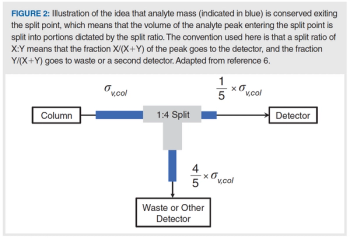
In this instalment, we focus on the impact of elution mode (isocratic or gradient) and postcolumn flow splitting on the total level of extracolumn dispersion (ECD) in a liquid chromatography (LC) system, and demonstrate the use of a free, web-based calculator that can be used to guide decision making aimed at reducing ECD during method development.

What leads to an asymmetric peak shape? Physiochemical phenomena can help chromatographers identify whether the cause of asymmetry has a chemical or physical origin.

Understanding when the effect is likely to be large enough to affect resolution is valuable for troubleshooting unexpected results that arise during both method development and the execution of established methods.

Column: LC Troubleshooting
As the field moves toward routine use of pressures well above 400 bar, the effect of pressure on retention should not be overlooked.

Several physical phenomena can lead to asymmetric peak shapes, including heterogeneity of the particle density inside the column, rearrangement of the particles over time, and accumulation of debris at the column inlet frit. This month’s instalment will focus on these potential physical causes.

In a continuing series on peak shapes, we focus on potential physical causes of asymmetry, including column packing, changes in the packed particle bed, and accumulation of debris in the column.

Tailing peaks—the most common type of asymmetric peak shape—can negatively affect both the qualitative and quantitative performance of LC methods. This instalment will discuss basic concepts in peak shape, and the potential for poor fluidic connections to cause peak tailing in a separation where the peak shape would otherwise be excellent.

In this first installment in a series on the causes of peak asymmetry, we discuss basic concepts in peak shape, explore poor fluidic connections as a common cause of peak tailing, and explain what to do about it.
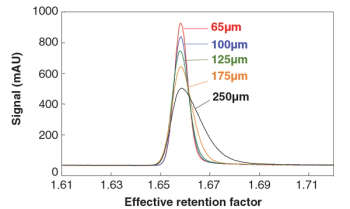
In recent articles, the authors reviewed the basic concepts of extracolumn dispersion and how this phenomenon can impact the quality of an LC separation. We now specifically discuss the effects of dispersion that can occur due to tubing and detectors.

In the final article of this series on extracolumn dispersion, we look at elution mode, post-column flow splitting, and a free calculator to use during method development.

Dispersion of analyte peaks outside of chromatography columns can seriously erode the resolution provided by good columns. Here, we focus on the contribution of the sample injection step to the total level of extracolumn dispersion in an LC system.

In recent articles, we reviewed the basic concepts of extracolumn dispersion and how this phenomenon can impact the quality of an LC separation. We now specifically discuss the effects of dispersion that can occur due to tubing and detectors.
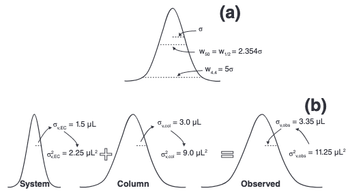
This instalment focuses on basic concepts in extracolumn dispersion (ECD) that occurs in high performance liquid chromatography (HPLC) systems, and the impact of this dispersion on the performance of columns of different dimensions and efficiencies.

Dispersion of analyte peaks outside of chromatography columns can seriously erode the resolution provided by good columns. Here, we focus on the contribution of the sample injection step to the total level of extracolumn dispersion in an LC system.

Dispersion of analyte zones outside of the column often compromises the quality of an LC separation—particularly in smaller columns with smaller particles. We explain basic concepts in extra-column dispersion from the point of view of an entire instrument.