

Troubleshooting continues to evolve constantly, changing how we overcome issues such as chemical causes of peak tailing.

Dwight R. Stoll is the editor of “LC Troubleshooting”. Stoll is a professor and the co-chair of chemistry at Gustavus Adolphus College in St. Peter, Minnesota, USA. His primary research focus is on the development of 2D-LC for both targeted and untargeted analyses. He has authored or coauthored more than 75 peer-reviewed publications and four book chapters in separation science and more than 100 conference presentations. He is also a member of LCGC’s editorial advisory board. Direct correspondence to: [email protected]
Troubleshooting continues to evolve constantly, changing how we overcome issues such as chemical causes of peak tailing.

Mobile phase degassing has become very useful for troubleshooting problems with pumps and detection.

As chromatography technology evolves, our use of it should change also. This article outlines a number of protective and troubleshooting methods for LC and how these approaches have changed over time.

The author outlines multiple protective and troubleshooting methods for liquid chromatography and how these approaches have changed over time.

Understanding the relationship between a number of variables and analysis time, and their effects on other choices made during method development, is helpful for developing methods that are both effective and time-efficient.

We present two cases where understanding the specific interactions between particular analyte functional groups and LC instruments and columns is critical for successful separations.
How to design scouting gradients, how to use the resulting data to make decisions about next steps, and how to improve the separation once an elution mode has been chosen.

Several factors strongly influence separation speed, including the pressure available to drive the separation, column temperature, particle size, and column length. Developing efficient methods to improve speed while not sacrificing accuracy require an understanding of the abovementioned variables and analysis time.

Building up knowledge of how different factors affect resolving power from a theoretical point of view, as well as what changes are possible within practical constraints, is powerful when we are confronted with a separation that needs to be improved, or when an existing separation is not performing as expected.
What are the options available when adjusting selectivity (peak spacing or elution pattern) when dealing with relatively simple mixtures?

Scouting gradients can simplify LC method development. Here’s what you need to get started using them.

The variables that are most important for improving the separation of complex samples are quite different from those for simpler samples. Considering these differences can save time and resources.

A systematic approach to method improvement can save time and resources by using methods that are likely to be better, and more robust, than those developed using a trial-and-error approach.

When can analyte retention deviate from what is expected or normal? We explain three subtle causes.

Even relatively simple mixtures are not always easy to separate. What are the options for adjusting selectivity in reversed-phase LC separations?

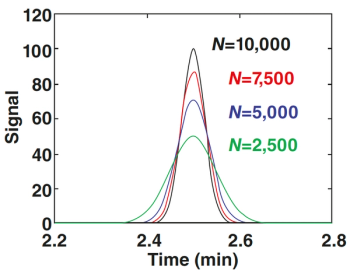
In this latest instalment of our series on recurring challenges in liquid chromatography (LC), we turn our attention to peak widths that are wider than expected. Estimating the expected peak widths can help determine when a column and LC system are not working quite right, and to decide when troubleshooting should be initiated.

When considering different ways to improve an established LC method, it helps to start by reviewing some essential concepts.
Developing a short list of the likely causes of these results can help streamline our troubleshooting experience when sensitivity-related problems occur.
Estimating expected peak widths helps us determine when a column and LC system is not performing optimally.

Knowing the tips and tricks of producing quality LC–MS data for peptide analysis can help streamline troubleshooting when problems occur.

This review article summarizes the results obtained from the combined efforts of a joint academic and industrial initiative to solve the real-life challenge of determining low levels of peptide-related impurities in the presence of the related biologically-active peptide at a high concentration.

Knowing the tips and tricks of producing quality LC–MS data for peptide analysis can help streamline troubleshooting when problems occur.

There are various physical and chemical causes of low detection sensitivity. Here, we address some of these causes, and how to troubleshoot them.

Some liquid chromatography (LC) troubleshooting topics never get old because there are some problems that persist in the practice of LC, even as instrument technology improves over time. There are many ways for things to go wrong in an LC system that ultimately manifest as detector baselines that do not look right. Developing a short list of the likely causes of these results can help streamline our troubleshooting experience when baseline-related problems occur.

When esterification occurs in your LC mobile phase, knowing how baseline quality, retention, and selectivity are affected will help you mitigate the effects.
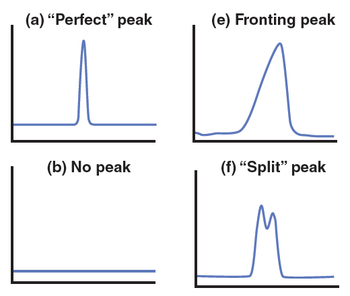
A critical step in any troubleshooting exercise—but one that I think is underappreciated—is recognizing that there is a problem to be solved.

Knowing the likely causes of baseline-related problems will help you solve them.

As 2D-LC becomes used more widely and in regulated laboratory environments, development and implementation of SSTs will be critical for successful routine use of the 2D-LC technique.

In this article, I share my perspective on the trends in 2D-LC, and the developments we are likely to see in the field in the near future.

As two-dimensional liquid chromatography (2D-LC) becomes more widely used, system suitability tests (SSTs) become even more important.