Many analysts have strongly held beliefs about buffer preparation methods, but these positions are not always supported by experimental evidence.

Dwight R. Stoll is the editor of “LC Troubleshooting”. Stoll is a professor and the co-chair of chemistry at Gustavus Adolphus College in St. Peter, Minnesota, USA. His primary research focus is on the development of 2D-LC for both targeted and untargeted analyses. He has authored or coauthored more than 75 peer-reviewed publications and four book chapters in separation science and more than 100 conference presentations. He is also a member of LCGC’s editorial advisory board. Direct correspondence to: amatheson@mjhlifesciences.com

Many analysts have strongly held beliefs about buffer preparation methods, but these positions are not always supported by experimental evidence.

When can we use completely aqueous eluents with reversed-phase stationary phases, and what happens if we make a mistake?

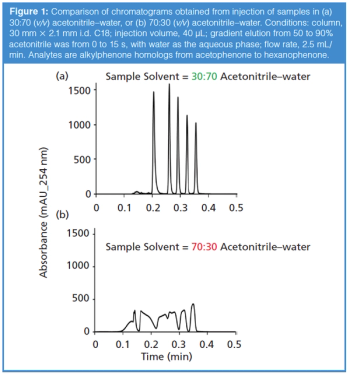
Adding an inline mixer between the sample injector and column in a liquid chromatography (LC) system can be an effective way to resolve problems with peak shape caused by the sample diluent.

An in-line mixer between the sample injector and column may resolve problems with peak shape caused during sample dilution.

Legacy LC methods seem like they come from a different planet. This month, we look at which conditions to keep, and which ones to let go.

Sometimes, the conditions specified in legacy liquid chromatography (LC) methods seem like they come from a different planet. This month, we look at which conditions to keep, and which ones to let go of.

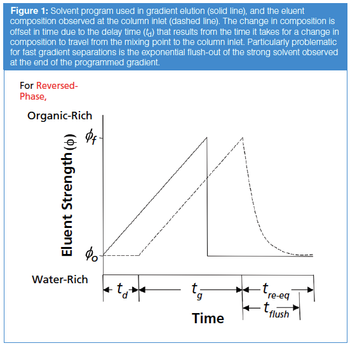
Re-equilibrating a reversed-phase stationary phase following aqueous gradient elution can be achieved much faster than you think.

How long does it take to re-equilibrate reversed-phase stationary phases following gradient elution, especially when starting with a highly aqueous eluent?

How long does it take to re-equilibrate reversed-phase stationary phases following gradient elution, especially when starting with a highly aqueous eluent?

The offerings of commercially available columns for reversed-phase liquid chromatography (LC) continue to expand. Are these columns similar or different compared to what is already available?

The challenges we face in troubleshooting problems with liquid chromatography (LC) separations are highly diverse. This month we take a closer look at topics that have garnered more attention recently.

How many new columns truly offer new selectivity?

In reversed-phase separations, retention generally increases as the fraction of water in the eluent increases. When we encounter situations where retention is too low for an analyte of interest, we tend to use eluents with higher and higher levels of water. But how much water is too much?

When can we use completely aqueous eluents with reversed-phase stationary phases, and what happens if we make a mistake?

The challenges we face in troubleshooting problems with liquid chromatography (LC) separations are highly diverse. This month we take a closer look at topics that have garnered more attention recently.

Is an ultraviolet (UV) detector signal good for anything if the analyst is using a mass spectrometer?

Several new materials and columns have been introduced in recent years for size-exclusion separations of proteins. How do I know which one to choose, and which separation conditions will be the best for my protein separation?

Is a mixer needed between the injector and column in high performance liquid chromatography (HPLC)?

What happens when we inject a sample into the mobile-phase stream? Many LC practitioners are surprised to learn just how serious the effect of the injected sample solvent can be.

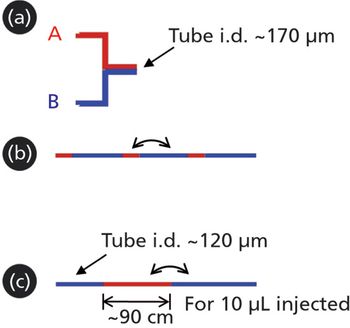
Many LC users are unclear what happens when we combine two (or more) flow streams in LC systems, and when mixers are needed to blend the fluids. This discussion explains why mixers are needed, and when and how you might consider using something other than the default mixer setting.

What types of mixers are needed with different types of liquid chromatography (LC) pumps? Are different mixers needed for different applications?

Much of the conventional wisdom regarding size-phase separations of proteins has been negated thanks to development of superior chemistries and advances in research. In this article, details that the authors have found to be especially beneficial in achieving effective SEC separations are examined.

Several new materials and columns have been introduced in recent years for size-exclusion separations of proteins. How do I know which one to choose, and which separation conditions will be the best for my protein separation?

Several new materials and columns have been introduced in recent years for reversed-phase separations of proteins. How do I know which one to choose, and which separation conditions will be best for my protein separation?

We examine instances where contaminants are problematic in LC–MS, as well as successful methods to decrease their influence.

Several new materials and columns have been introduced in recent years for reversed-phase separations of proteins. How do I know which one to choose, and which separation conditions will be best for my protein separation?

For reversed-phase separations of proteins, you must consider pore size,column temperature, and stationary-phase chemistry. Here are some guidelines.

Is that peak “pure”? How do I know if there might be something hiding under there?

Is that peak “pure”? How do I know if there might be something hiding under there?

Here, we see how 2D-LC can solve coelution problems that are difficult or impossible to address using peak purity tools or curve resolution methods.