Articles by John V. Hinshaw

This month's installment of "GC Connections" discusses factors that can help determine which type of liquid injection technique is appropriate for specific samples, including having to use existing inlet systems that are on-hand in the laboratory with samples for which they might not be ideally suited.

This month's installment of "GC Connections" discusses factors that can help determine which type of liquid injection technique is appropriate for specific samples, including having to use existing inlet systems that are on-hand in the laboratory with samples for which they might not be ideally suited.

I started writing for LCGC in the summer of 1987. At the time, I was involved with an instrument company team specifying a new gas chromatograph.
The 58th Pittsburgh Conference on Analytical Chemistry and Applied Spectroscopy was held February 25 to March 1, 2007, at McCormick Place in Chicago, Illinois.

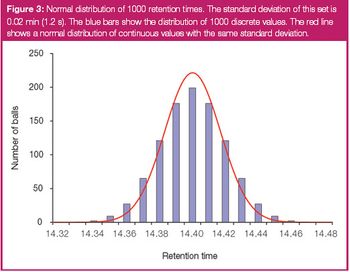
The accuracy and precision of results in gas chromatography and other analytical techniques are highly dependent upon the sample and its preparation, the instrumentation, accessories and operating conditions, as well as operator skill and experience. For these reasons, accuracy and precision for a specific methodology can be expected to vary from one laboratory or operator to another. This month, we look at statistical analysis as a diagnostic tool.

Setting realistic expectations requires a good working knowledge of an instrument's capabilities in terms of the sample requirements as well as an understanding of the effects of real-world samples and their matrices on long-term instrument performance.

The accuracy and precision of results in gas chromatography and other analytical techniques are highly dependent upon the sample and its preparation, the instrumentation, accessories and operating conditions, as well as on operator skill and experience. For these reasons, accuracy and precision for a specific methodology can be expected to vary from one laboratory or operator to another. This month, we look at statistical analysis as a diagnostic tool.
November 2006. This month, John Hinshaw addresses questions of instrument capabilities and chromatographers' expectations. In subsequent issues, he will discuss adjustment of hardware settings, optimization of column parameters, and data-handling issues. This is the first article in the recently released "GC Connections Resource Guide."
Most modern GC autosamplers employ high-speed actions by default.
September 2006. The accuracy and precision of results in gas chromatography and other analytical techniques are highly dependent upon the sample and its preparation, the instrumentation, accessories, and operating conditions, as well as on operator skill and experience. For these reasons, accuracy and precision for a specific methodology can be expected to vary from one laboratory or operator to another. This month, we look at statistical analysis as a diagnostic tool.

This month, John Hinshaw discusses how to make, maintain, and troubleshoot various types of connections used in gas chromatographs.

Thermal conductivity detectors have been in use since before the beginning of gas chromatography. Essential for fixed-gas detection - no substitute has the same ease of use and stability - thermal conductivity detectors are also employed when the auxiliary or combustion gases required by flame ionization or other detectors are unsafe or impractical. Although they cannot match the sensitivity of ionization detectors, thermal conductivity detectors are the third most used detector, surpassed only by flame ionization and bench-top mass-spectrometry detectors. This month's instalment of "GC Connections" takes a look at the operating principles and inner workings of the thermal conductivity detectors.

In his annual installment, John Hinshaw takes a look at the new gas chromatography instruments and accessories that were on display at Pittcon this year.

Overall FID sensitivity depends upon the combustion gas flow-rates, the carrier-gas flow-rate, the flame jet exit diameter, the relative positions of jet and collector and, to a lesser degree, the detector temperature.

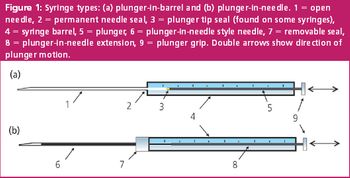
In this month's edition, John Hinshaw takes a look at how choosing a suitable syringe for a specific application can be difficult, especially if the inlet system has special requirements; choosing the wrong syringe ca cause significant problems.

There are three basic types of silica glass that have been used for capillary columns: sodium, borosilicate and fused silica.

Thermal conductivity detectors have been in use since before the beginning of gas chromatography. Essential for fixed-gas detection - no substitute has the same ease of use and stability - thermal conductivity detectors also are employed when the auxiliary or combustion gases required by flame ionization or other detectors are unsafe or impractical. Although they cannot match the sensitivity of ionization detectors, thermal conductivity detectors are the third most used detector, surpassed only by flame ionization and bench-top mass-spectrometry detectors. This month's installment of "GC Connections" takes a look at the operating principles and inner workings of the thermal conductivity detectors.

Flame ionization detection (FID) is the most commonly used gas chromatography (GC) detection method. Flame ionization detectors respond to a wide assortment of hydrocarbons, have a large dynamic range, are...
In this installment of "GC Connections," the author reviews some of the developments infused-silica solumn technology and then takes a brief tour through the process of column manufacturing.

The trend towards dedicated analytical solutions continues to gain momentum while what might have been considered high performance instrumentation a few years ago are increasingly being viewed as routine techniques.

A review of the latest products and innovations in gas chromatography to come out of Pittcon 2005.

John Hinshaw asks what constitutes a chromatographic method and addresses some of the issues that method transfer raises for method documentation and validation.
In the concluding part of this series, the effects that column variability has on isothermal capillary gas chromatography is discussed and instrument calibration explored. The goal is to reduce the normal variability that occurs when working with multiple instruments and columns to ensure consistent results.
The best approach is to document everything for each hardware configuration as a separate method and then qualify and validate them for each sample or category of sample.
In this first of a two-part series, John Hinshaw discusses the relative effects that inlet pressures and oven temperatures have on capillary gas chromatography.
In this first of a two-part installment, John Hinshaw discusses the relative effects that inlet pressures and oven temperatures have on capillary gas chromatography.
This instalment of GC Connections examines the basics of peak identification and quantification and demonstrates how they can both influence the quality of one's results as much as or even more than sample preparation, separation and detection.
This month's "GC Connections" examines the various ways – and their attendant benefits and drawbacks – with which chromatographers and chromatography data-handling systems locate and measure peaks
In response to a reader's question, John Hinshaw examines the effects on retention times and peak shapes when a retention gap is added to a capillary column.

