Articles by Jordy J. Hsiao
Hydrophilic interaction chromatography–mass spectrometry (HILIC-MS) offers a flexible and efficient alternative to ion-pairing reversed-phase liquid chromatography (IP-RPLC) for oligonucleotide analysis, with column selectivity and mobile phase pH being key factors in optimizing retention and detection.
If you are analyzing metal-sensitive biomolecules, and a bioinert instrument is unavailable, or insufficient, passivation or mobile-phase additives may help. Here’s how to use those solutions, with tips for avoiding potential pitfalls.

Bioinert and biocompatible liquid chromatography (LC) systems are becoming more commonplace in laboratories, but the majority of biomolecule separations still use LC systems composed primarily of stainless steel parts. Can passivation or mobile phase additives improve separations on these systems for metal-sensitive biomolecules?

How do I know when bioinert liquid chromatography columns, systems, or components are needed for my separations of biomolecules?
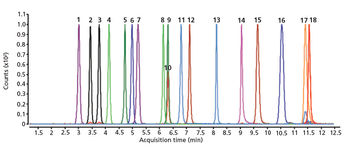
This article highlights the use of a new HILIC zwitterionic phase on superficially porous particles. A study on the use of a novel mobile-phase additive to achieve superior peak shape and isomer separation is also discussed, as well as improved LC–MS detection capabilities for metabolomics analysis.