Kevin A. Schug

Kevin A. Schug is a Full Professor and Shimadzu Distinguished Professor of Analytical Chemistry in the Department of Chemistry & Biochemistry at The University of Texas (UT) at Arlington. He joined the faculty at UT Arlington in 2005 after completing a Ph.D. in Chemistry at Virginia Tech under the direction of Prof. Harold M. McNair and a post-doctoral fellowship at the University of Vienna under Prof. Wolfgang Lindner. Research in the Schug group spans fundamental and applied areas of separation science and mass spectrometry. Schug was named the LCGC Emerging Leader in Chromatography in 2009, and most recently has been named the 2012 American Chemical Society Division of Analytical Chemistry Young Investigator in Separation Science awardee.

Articles by Kevin A. Schug

equation 2.png

The literature on reversed-phase liquid chromatography (LC) of proteins is reasonably well developed, but not taught in the college classroom much. Kevin Schug therefore wants to focus on a stoichiometric displacement model for reversed-phase LC of proteins and why it is particularly insightful from a practical perspective.

The literature on reversed-phase liquid chromatography of proteins is reasonably well developed, but not taught in the college classroom to a significant degree. So I would like to focus on a stoichiometric displacement model for reversed-phase LC of proteins that I found to be particularly insightful from a practical standpoint.

There is a shortcoming in our current educational system. There is too much rote learning, and not enough time given to let science-minded students explore a topic. Overall, when students ask their own questions (not ones given to them by instructors), they become more invested in finding the answers.

Horizon_Table1_web-New-1437574580574.jpg

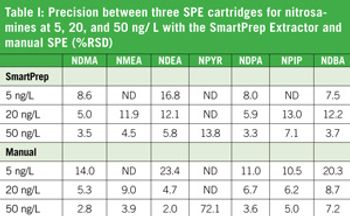
Disinfection by-products (DBP) are an ever-present nuisance in the efforts to purify drinking water, wastewater, and municipal waters from various sources. An emerging class of DBP compounds with health effects is nitrosamines which result from chloramination or chlorination if the water is nitrogen-rich. Five of these nitrosamines have been listed on the US EPA’s new Contaminant Candidate List (CCL-3). Of the nitrosamines, the most common and problematic is N-nitrosdimethylamine (NDMA). The maximum admissible levels set by the US EPA are 7 ng/L for NDMA and 2 ng/L for N-nitrosodiethylamine (NDEA).

I have had enough conversations with experts in the field of high performance liquid chromatography (HPLC) stationary-phase supports to know that there is more to the increased efficiency provided by the use of superficially porous particles (SPP) compared to fully porous particles (FPP) than simply mass transfer effects. Yet, I would argue that this is still one of the biggest misconceptions propagated by some members of the chromatography community.