

LCGC Europe
A review of the trends at this year's symposium, including discussions of column technology, sample preparation, and detector usage.

Ron Majors, editor of "Column Watch" and "Sample Prep Perspectives," has been with LCGC North America for over 26 years. Currently a senior scientist with Agilent Technologies, Wilmington, Delaware, Ron is known industry-wide as one of the premier chromatography experts in the field. He is also a member of LCGC's editorial advisory board.
LCGC Europe
A review of the trends at this year's symposium, including discussions of column technology, sample preparation, and detector usage.

LCGC North America
A review of the advances and trends in technology and applications discussed at the HPLC 2013 conference, including a summary of the awards presented.

LCGC Asia Pacific eNews
Part 1 of evidence to demystify HPLC and UHPLC column myths
LCGC North America
A summary of the results from a survey of 14 leading HPLC–UHPLC column experts is presented, covering the state of sub-2-?m porous particles, superficially porous (core–shell) particles, silica monoliths, and polymeric monoliths.
LCGC North America
Evidence to demystify HPLC and UHPLC column myths
LCGC North America
For the next improvements, we must look beyond the column.

LCGC Europe
Part I of Ron Major's report on new products introduced at Pittson. This month, columns are highlighted, covering all modes of high performance liquid chromatography (HPLC), ultrahigh-pressure liquid chromatography (UHPLC), and liquid-phase separations.
LCGC North America
This month's installment of "Column Watch" comprises Part II of our yearly report on new products introduced at Pittcon. Gas chromatography columns, sample preparation products, and hardware, accessories, and small tabletop instruments mainly for sample preparation are covered.

Special Issues
A brief introduction to this special supplement by Guest Editor Ron Majors
LCGC North America
Part I of our yearly report, covering columns for all modes of HPLC, UHPLC, and liquid-phase separations.

LCGC Asia Pacific
This article discusses the details of how the newer techniques of sample prepaation are simplified by the use of LC–MS–MS and GC–MS–MS technology.

LCGC North America
The results from a reader survey on sample preparation techniques

LCGC Europe
This short review covers the use of ionic liquids (ILs) and polymeric ionic liquids (PILs) in solid-phase microextraction (SPME) and dispersive microextraction (DLLME)
LCGC North America
Howard G. Barth and Ronald E. Majors Liquid–solid extraction is the most popular method, but sometimes modern approaches such as PLE/ASE and MAE are possible.
LCGC Europe
This instalment focuses on approaches and techniques for extracting and concentrating small molecules of interest present in polymeric materials.
LCGC Europe
This article discusses the details of how the newer techniques of sample preparation are simplified by the use of LC–MS-MS and GC–MS-MS technology.
LCGC North America
By achieving selectivity in other portions of the analytical cycle, we can lower the burden on sample preparation.
LCGC North America
A review of the trends at this year&s symposium, including discussions of column technology, sample preparation, and detector usage.

LCGC Europe
This article provides examples of the use of SLE, demonstrates some of its advantages and provides commercial sources for SLE products.
LCGC North America
An alternative approach to liquid–liquid extraction is explored.

LCGC Asia Pacific
This month's "Sample Prepartion Perspectives" describes practical aspects of hollow-fibre liquid-phase microextraction in the three phase mode (HF3LPME) and also electromembrane extraction (EME), which uses an electrical potential as the driving force for the extraction.
LCGC North America
What you need to know about gas chromatography columns, thin-layer chromatography plates, sample preparation products, as well as chromatography and sample preparation accessories (including small benchtop instruments) unveiled at Pittcon this year

LCGC Europe
A review of the historical development and latest trends in phase development in the field of chiral capillary gas chromatography. A range of novel applications in chiral capillary GC are also described.
LCGC North America
A review of columns unveiled at Pittcon this year, including all modes of HPLC, UHPLC, and liquid-phase separations.
Special Issues
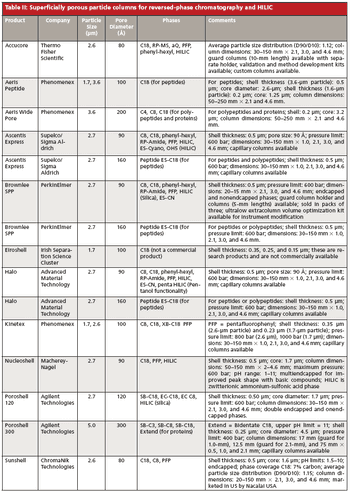
A discussion of new column packing materials - including sub-2-µm particles, superficially porous particles, and second-generation monoliths - and their impact on instrumentation and laboratory productivity
LCGC Asia Pacific
The results of a recent survery on stationary phases used in high performance liquid chromatography (HPLC) are revealed.

LCGC Europe
This article looks at selectivity throughout the whole sample analysis cycle from the sampling stage, through sample preparation, sample introduction, analyte separation, analyte detection, data analysis and report generation.
LCGC Europe
The results of a recent survey on stationary phases used in high performance liquid chromatography (HPLC) are revealed.
LCGC North America
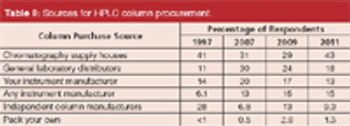
The results of a recent survey on high performance liquid chromatography (HPLC) columns shows some interesting changes.