

LCGC North America
Ron Majors discusses the technique of Salting-out Liquid-Liquid Extraction (SALLE) and provides some examples of its successful applications.

Ron Majors, editor of "Column Watch" and "Sample Prep Perspectives," has been with LCGC North America for over 26 years. Currently a senior scientist with Agilent Technologies, Wilmington, Delaware, Ron is known industry-wide as one of the premier chromatography experts in the field. He is also a member of LCGC's editorial advisory board.
LCGC North America
Ron Majors discusses the technique of Salting-out Liquid-Liquid Extraction (SALLE) and provides some examples of its successful applications.

LCGC North America
Ron Majors provides an unbiased look at this present crisis and gives alternative solutions.

LCGC North America
Ron Majors brings readers the second part of his yearly review of all that was new and innovative at the annual Pittsburgh Conference.
LCGC North America
Ron Majors brings readers his yearly review of all that was new and innovative at the annual Pittsburgh Conference.

LCGC Europe
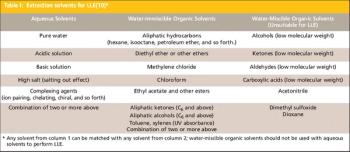
Columnist Ron Majors discusses some of the practical considerations in the successful application of the popular yet age-old technique of solvent extraction (also known as liquid–liquid extraction, or LLE). After a brief review of the basics, guidelines on the selection of the appropriate extraction solvents and how to use acid–base equilibria to ensure efficient extractions of ionic and ionizable compounds are provided. Problems in LLE and the solutions to these problems are highlighted. A newer technique called dispersive liquid–liquid microextraction (DLLME) is introduced.
The Application Notebook
Columnist Ron Majors discusses some of the practical considerations in the successful application of the popular yet age-old technique of solvent extraction (also known as liquid–liquid extraction, or LLE). After a brief review of the basics, guidelines on the selection of the appropriate extraction solvents and how to use acid–base equilibria to ensure efficient extractions of ionic and ionizable compounds are provided. Problems in LLE and the solutions to these problems are highlighted. A newer technique called dispersive liquid–liquid microextraction is introduced.

LCGC North America
Guest authors show how mixed modes can be used successfully in the optimization of protein purification, and discuss how various experimental parameters can be used to regulate the binding of proteins to mixed-mode sorbents.
LCGC North America
Columnist Ron Majors discusses some of the practical considerations in the successful application of the popular yet age-old technique of solvent extraction (also known as liquid–liquid extraction, or LLE).
LCGC North America
This installment of SPP will compare and contrast the various types of polymeric and non-polymeric sorbents. The major advantages or polymeric sorbents will be discussed, and some applications will illustrate the versatility of polymeric SPE.
LCGC North America
A variety of chromatographic sorbents are commercially available for reversed-phase liquid chromatography (RPLC) and while many of these columns are nominally similar, in practice the columns may provide significantly different separations.
LCGC North America
Ron Majors continues his summary of the technical highlights of HPLC 2008, discussing more hot topics from the show.
LCGC North America
HPLC 2008 was held in Baltimore in May. Columnist Ron Majors covers the highlights of this major symposium, held in the U.S. every two years.
LCGC North America
Guest Editor Peter Schoenmakers provides an introduction to LCxLC, and then goes on to talk about peak capacity, sample dimensionality, phase orthogonality, and some of the successes of the technique and the obstacles yet to be overcome.
LCGC North America
Guest columnsist and LCGC Emerging Leader award recipient Gert Desmet considers the different methods that can be used to compare the performance of LC columns.

LCGC Europe
In this instalment of "Column Watch", columnist Ron Majors examines the role of pressure in high performance liquid chromatography (HPLC) from two viewpoints: the impact of the ultrahigh pressures encountered in ultrahigh-pressure liquid chromatography (UHPLC) on chromatographic parameters and increases in column pressure encountered in normal daily use. The latter is of more practical consequence to HPLC users because increased back pressure usually implies that something has gone wrong with the column. Pressure increases as a result of physical and chemical contamination are explored and practical approaches to solve these problems are suggested.

Special Issues
It has often been stated (or maybe overstated) that the column is the heart of the chromatograph. Without the proper choice of column and appropriate operating conditions, method development and optimization of the high performance liquid chromatographic (HPLC) separation can be frustrating and unrewarding experiences. Since the beginning of modern liquid chromatography, column technology has been a driving force in moving separations forward. Today, the driving forces for new column configurations and phases are the increased need for high throughput applications, for high sensitivity assays and to characterize complex samples such as peptide digests and natural products.

LCGC North America
This month's installment of "Column Watch" is the second part of a two-part series in which columnist Ron Majors examines the trends and highlights in columns and consumables at Pittcon 2008.

Special Issues
In the leadoff article, columnist Ron Majors provides an overview of column developments. He looks at various alternatives to high-throughput separations including small porous particles, monoliths and superficially-porous particles. Microfluidics and parallel column systems provide further alternatives. An alternative approach to isocratic method development uses optimized stationary phase combinations. Brief coverage of new phases for hydrophilic interaction chromatography, high temperature operation, chiral and mixed mode columns and finally supercritical fluid chromatography columns round out the overview. At the conclusion, Majors speculates on future directions in column technology.
LCGC North America
This month's installment of "Column Watch" is the first of a two-part series in which columnist Ron Majors examines the trends and highlights in columns and consumables at Pittcon 2008.
LCGC North America
In 2001, the second glossary of common and not-so-common terms and "buzz words" for reference to HPLC columns and column technology was published. It is time for an update since new terms have arisen or, in some cases, their original meanings have expanded or changed.
LCGC North America
In this installment of "Column Watch," Ron Majors examines the various approaches to increasing the speed of high performance liquid chromatography (HPLC) separations.
LCGC Europe
Selective sample preparation techniques are particularly attractive for the analysis of trace amounts of small molecules in complex matrices. In this month's instalment, columnist Ron Majors covers the field of immunoextraction, a technique that employs immobilized antibodies to selectively capture specific analytes using molecular recognition via antibody–antigen interactions. Recently, the introduction of commercial products for specific high-volume environmental and food safety applications should spur further applications of this technique.

LCGC North America
In this month?s installment, columnist Ron Majors covers the field of immunoextraction, a technique that employs immobilized antibodies to selectively capture specific analytes using molecular recognition via antibody?antigen interactions. Recently, the introduction of commercial products for specific high-volume environmental and food safety applications has spurred further applications of this technique.

LCGC North America
In this installment of "Column Watch," columnist Ron Majors examines the role of pressure in high performance liquid chromatography (HPLC) from two viewpoints: the impact of the ultrahigh pressures encountered in ultrahigh-pressure liquid chromatography (UHPLC) on chromatographic parameters and increases in column pressure encountered in normal daily use. The latter is of more practical consequence to HPLC users since increased back pressure usually implies that something has gone wrong with the column. Pressure increases due to physical and chemical contamination are explored and practical approaches to solve these problems are suggested.

LCGC Europe
This month's instalment of "Sample Prep Perspectives" describes a new extraction technique called QuEChERS (standing for quick, easy, cheap, effective and safe and is pronounced "catchers") for the sample preparation of pesticides in foods and agricultural samples. The technique uses simple glassware, a minimal amount of organic solvent and various salt/buffer additives to partition analytes into an organic phase for clean up by dispersive solid-phase extraction (d-SPE). The technique provides good recoveries, is reproducible and costs less than other sample preparation approaches. The technique is being adopted by many laboratories worldwide. It has the potential for applications outside of the pesticide in foods area.
LCGC North America
HPLC 2007 was held in Ghent, Belgium in June. Last month, columnist Ron Majors summarized some the important column developments as well as other Symposium highlights. This month, he winds up coverage with additional highlights in the areas of technology and applications. Among the topics covered are stationary phase preparation and characterization, multi-dimensional and comprehensive LC, temperature studies, detectors and an application overview.

LCGC Asia Pacific
In this instalment of "Sample Preparation Perspectives", columnist Ron Majors discusses advanced topics such as multimodal SPE, restricted-access media, molecular imprinted polymers, immunoaffinity extraction phases and other class-or compound-specific sorbents...
LCGC North America
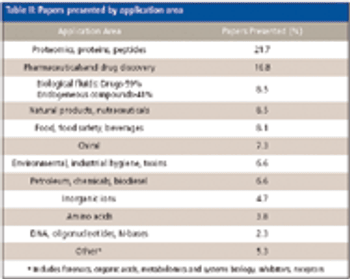
Columnist Ron Majors covers some of the highlights of HPLC 2007 including honorary sessions, best poster awards, and the latest developments in HPLC column technology.
LCGC North America
In this month's issue, columnist Ron Majors and coauthors discuss the important steps in the successful production of fused-silica gas chromatography (GC) capillary columns.
LCGC North America
In early 2007, a web-based HPLC columns survey was conducted. Current usage was compared to a 1997 survey.