The Application Notebook-06-01-2009

i4-601843-1408649201648.jpg

The Application Notebook

Morphine is an effective pain-relieving drug that is primarily metabolized into morphine-3-glucuronide (M3G) and morphine-6-glucuronide (M6G). The highly potent M6G may have adverse effects, such as respiratory depression and renal failure, if accumulated in the body. As morphine abuse continues to affect modern society, an effective method must be established to analyse morphine and its structurally related compounds in biological fluid samples. In this work, a UPLC–MS-MS method was developed to separate six morphine-related compounds on a 2.1 Ã- 100 mm, 1.8 μm ACQUITY UPLC HSS T3 column in a single run using an ACQUITY UPLC system connected to a fast-scanning triple-quadrupole MS detector (TQD). The method achieved adequate retention of these very polar compounds by reversed-phase (RP) chromatography in an 8-min total run time.

i1-601826-1408649284581.jpg

The Application Notebook

Over the past 15 years, little has changed for the commercial environmental laboratory's ability to automate U.S. EPA Method 8260 for water and soil purge and trap analysis. As work loads have increased, reporting levels have decreased due to MS sensitivity improvements. However, it has become increasingly difficult for laboratories to run at high levels of productivity due to autosampler reliability, carryover, and internal standard reproducibility challenges. Each of these issues has been addressed in a new Centurion WS autosampler (see Figure 1) designed specifically for the commercial environmental laboratory.

i1-601850-1408649183726.jpg

The Application Notebook

Since the introduction of high-performance liquid chromatography (HPLC) nearly 40 years ago, many improvements have been made to column stationary phases to achieve faster, more efficient separations. HPLC columns containing superficially porous (sometimes called fused-core) particles have recently gained increasing attention. Though this technology is not entirely new, it has been improved to the point where rapid, highly efficient separations can be achieved for some applications.

i1-601838-1417780039021.jpg

The Application Notebook

Illegal drug use worldwide is at an all time high. Forensic laboratories are seeing increased sample loads creating an immediate need for fast and accurate analysis to positively identify confiscated materials in criminal investigations. This application highlights the value of gas chromatography with time-of-flight mass spectrometry (GC-TOFMS) for drug testing in forensic laboratories. A method was developed to successfully identify twenty drugs of abuse in 4.5 min. This GC-TOFMS method shows good chromatographic peak shape for even the most challenging drug analytes; even the peak shapes for amphetamine and methamphetamine were exceptional considering they were analyzed underivatized. The total ion chromatogram (TIC) for the twenty drug analytes is shown in Figure 1.

i1-601828-1408649273246.jpg

The Application Notebook

Synthetic fused silica capillary tubing is a vital component in many scientific techniques. The general perception is that most laboratory glass products are fragile and easy to break. The opposite is true of fused silica capillary; with its protective coating it is both strong and durable when handled properly.

i1-601851-1408649181738.jpg

The Application Notebook

Salt formation is a critical aspect in drug development (1) and HPLC is an important tool for determination of pharmaceutical counterions. Reversed-phase columns often fail to retain very hydrophilic counterions. Ion chromatography (IC) is preferred for selective and sensitive screening of cationic and anionic pharmaceutical counterions (2), usually with multiple runs. Positive and negative counterions can be separated simultaneously using a zwitterionic HILIC column using an evaporative light scattering detector (3). However, the zwitterionic column method has limitations: 1) limited to HILIC mode; 2) ions are retained as salts rather than via ion-exchange, making method development difficult; and 3) the method is not suitable for simultaneous separation of acidic, basic, and neutral analytes.

i1-601824-1408649288770.jpg

The Application Notebook

D-Mannose-6-phosphate (M-6-P) is a terminal monosaccharide of some asparagine-linked (N-linked) oligosaccharides and is also part of an important intermediate in N-linked oligosaccharide biosynthesis. Some lysosomal glycoproteins require M-6-P terminated oligosaccharides for proper targeting and function. Lack of M-6-P or genetic defects in its synthesis or subsequent processing can result in a variety of diseases.

i1-601844-1408649199474.jpg

The Application Notebook

This application note describes a fast LC method for the analysis of water-soluble vitamins using a Thermo Scientific Hypersil GOLD aQ column.

i1-601823-1408649293659.jpg

The Application Notebook

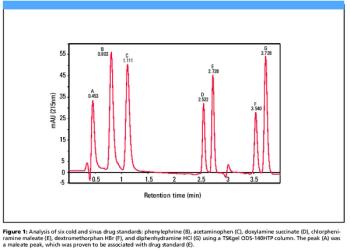
Since the USA Patriot Act* has been enacted, many pharmaceutical companies have reformulated their over the counter (OTC) drug products with phenylephrine (a nasal decongestant) as a substitute for pseudoephedrine. Phenylephrine comes as a tablet, a liquid, or a dissolving strip to take orally - all as a treatment for cold symptoms (1). Besides phenylephrine, most pharmaceutical formulations for common cold and sinus medications often contain multiple active ingredients to treat different types of symptoms in addition to numerous excipients. From an analytical perspective, the challenge is to develop chromatographic conditions that allow quantitative analysis of a variety of excipients that vary widely in hydrophobic properties.