LCGC Europe-06-01-2017

figure 11496851531969.png

LCGC Europe

Some 50 years after Giddings’s iconic comparison of the separation speed of gas chromatography (GC) and liquid chromatography (LC), the authors revisit this comparison using kinetic plots of the current state‑of‑the-art systems in LC, supercritical fluid chromatography (SFC), and GC. It is found that, despite the major progress LC has made in the past decade (sub-2-µm particles, pressures up to 1500 bar, core–shell particles), a fully optimized ultrahigh-pressure liquid chromatography (UHPLC) separation is still at least one order of magnitude slower than capillary GC. The speed limits of packed bed SFC are situated in between.

offer.png

LCGC Europe

When you want to adjust a United States Pharmacopeia (USP) method for a different size column or to meet system suitability criteria that fail, how much of a change can you make without revalidating the method?

figure 1 L.png

LCGC Europe

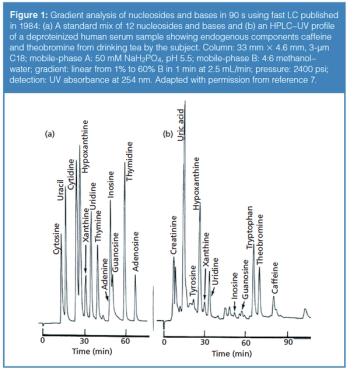
This instalment highlights historical perspectives on the development of ultrahigh-pressure liquid chromatography (UHPLC) into a modern high performance liquid chromatography (HPLC) platform and describes the important instrumental features common to most commercial equipment.

figure 1 l1497003310221.png

LCGC Europe

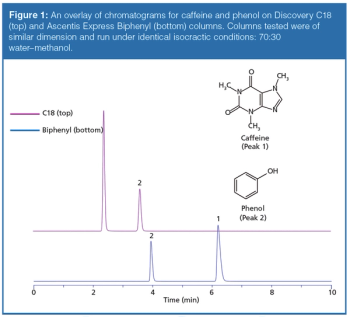
In reversed-phase liquid chromatography (LC), C18 alkyl-based stationary phases have been the favourite of method developers. Phenyl stationary phases are an alternative that are thought to benefit from additional π-π mechanisms. Recently, there has been a growing interest in the use of phases based on the biphenyl moiety. This instalment of “Column Watch” looks at the retention mechanisms of biphenyl phases and contrasts them with those of more-common alkyl phases.