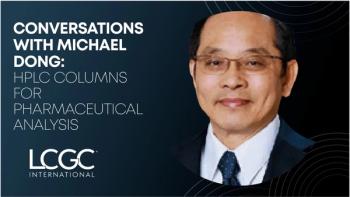
In Part 2 of "Conversations with Michael Dong," the LCGC column editor discusses HPLC columns for pharmaceutical analysis and the case for short columns.
The Pittsburgh Conference on Analytical Chemistry and Applied Spectroscopy (Pittcon) has served as a major international meeting for analytical scientists across academia, industry, and government laboratories for more than 75 years. Pittcon 2026 will take place March 7–11, 2026, at the Henry B. González Convention Center in San Antonio, Texas, under the conference theme The Scientific Frontier.
For chromatographers, Pittcon remains a premier venue where method development, instrumentation advances, and applied separations research are presented alongside short courses and vendor-led technical demonstrations. The 2026 program includes extensive coverage of liquid chromatography (LC), gas chromatography (GC), ion chromatography (IC), multidimensional separations, and hyphenated techniques, with strong representation from pharmaceutical, bioanalytical, environmental, and emerging regulated markets.
San Antonio is home to a growing bioscience and healthcare sector, a significant energy and environmental analytics presence, and defense-related research organizations that rely heavily on chromatographic and mass spectrometric (MS) methods. The region includes multiple universities, large hospital systems, and industrial laboratories engaged in analytical testing and method development.
The Henry B. González Convention Center is centrally located, with adjacent hotels and convenient access to conference sessions, short courses, and the exposition floor. This layout supports efficient movement between technical presentations, vendor interactions, and informal professional discussions.
The conference opens with the Wallace H. Coulter Keynote Lecture, presented in 2026 by Professor Frances H. Arnold of the California Institute of Technology, Nobel Laureate in Chemistry. Her lecture, Innovation by Evolution: Bringing New Chemistry to Life, will focus on directed enzyme evolution and catalyst design.
While not chromatography-specific, the topic is highly relevant to analytical scientists working with biologics, enzymatic processes, and complex molecular systems that increasingly require advanced chromatographic characterization.
Chromatography-related content is distributed across several technical tracks, including Bioanalytical & Life Science, Pharmaceutical & Biologic, Environment & Energy, and Cannabis & Psychedelic Science. Sessions emphasize practical considerations such as separation mechanisms, stationary-phase selection, sample preparation, method robustness, and integration with MS.
On Monday, March 9, 2026, Room 304B will host a series of presentations focused on advancing new-modality drug development through automation, digitization, and artificial intelligence/machine learning (AI/ML). The session begins at 8:30 a.m. with Tao Chen of Genentech, Inc., who will present Self-Driving Laboratories for Synthetic Molecule Process Development, highlighting how automation can improve efficiency and reproducibility in early-stage research.
Adrian Ramirez Galilea of Takeda will then deliver Comprehensive Automated Solutions for Drug and Biomarker Analysis, examining integrated approaches that streamline complex analytical workflows. Following this talk, Weiyue Xin of Merck will introduce A Fully Autonomous Solubility Workstation for Small Molecule Drug Development, demonstrating its application in accelerating solubility testing with consistent accuracy. The morning session concludes with Michael Rerick of GSK, who will provide insights in Applying Automation and Digital Tools to Support Drug Discovery and Development.
The session entitled Innovative Analytical Characterization of New Drug Modalities and Drug Delivery Tools will bring together industry experts on Tuesday, March 10, 2026, from 8:30 to 10:40 a.m. in Room 304B to explore emerging analytical strategies for the characterization of increasingly complex therapeutic modalities. The session will highlight advances in analytical tools that support the development of oligonucleotide therapeutics, antibody–drug conjugates (ADCs), and next-generation drug delivery technologies, with an emphasis on method development, structural characterization, and quality attribute assessment.
The symposium will open with a focus on RNA therapeutics. Molly Blevins of Genentech will present Insights into siRNA Duplex Stability from UV–Vis Concentration and Melting Temperature Analyses, describing how spectroscopic techniques can be applied to evaluate siRNA duplex integrity, thermal stability, and formulation-relevant properties critical to therapeutic performance.
Attention will then turn to antibody–drug conjugates. Xiuyuan (Maggie) Ma of AbbVie will present Innovative Analytical Characterization to Assess Key Quality Attributes of Antibody–Drug Conjugates, highlighting integrated analytical workflows used to evaluate ADC heterogeneity, conjugation efficiency, and stability, and their impact on product quality and regulatory considerations.
Advanced mass spectrometry approaches will also be featured. Marcelino Varona Ortiz of Genentech will present High-Resolution Ion Mobility Mass Spectrometry Enables Sequencing and Characterization of Synthetic Guide RNA, demonstrating how ion mobility-enabled separations can provide enhanced structural resolution and sequencing confidence for complex nucleic acid therapeutics.
The session will conclude with chromatographic strategies for ADC analysis. Thamara Janaratne of Denali Therapeutics, Inc., will present Hydrophobic Interaction Chromatography (HIC) Method Development and Extended Characterization of Drug-to-Antibody Ratio (DAR) Variants in Site-Specific PBD-ADCs, discussing method optimization and the role of HIC in resolving DAR species and supporting site-specific conjugation strategies.
The session titled Protecting the World’s Natural Resources: Water Pollution will take place on Monday, March 9, 2026, from 8:30 to 10:40 a.m. in Room 303A. This session brings together experts in environmental analysis to address emerging and persistent water contaminants using advanced analytical and mass spectrometric techniques. Presentations will focus on contaminant identification, quantification, environmental fate, and implications for public health and sustainability.
The session will open with a focus on per- and polyfluoroalkyl substances (PFAS). Ethan Hain of Shimadzu Corporation will present PFAS Analysis 2026: Innovations in Compound Identification and Quantification, highlighting recent advances in analytical strategies for detecting and measuring these complex and environmentally persistent compounds.
Attention will then turn to pharmaceuticals and personal care products in the environment. Kevin Tucker of Southern Illinois University Edwardsville will present Pharmaceuticals and Personal Care Products in Soil and Water: Mass Spectrometry Insights into Emerging Contaminants, examining how modern mass spectrometric tools are being applied to track and characterize these increasingly prevalent pollutants.
Following a brief transition, the session will address microplastics in environmental matrices. Damià Barceló of the Universidad de Almería will present Sustainable Analytical Approaches for Microplastics in Wastewater, Sludge, and Landfills: Challenges, Fate, and Green Chemistry Perspectives, discussing analytical challenges, environmental behavior, and sustainable methodologies for microplastic analysis.
The session will conclude with a focus on drinking water safety. Jiafu Li of the University of South Carolina will present Improving Drinking Water Safety: Addressing New Impacts and Identifying Important Toxicity Drivers Using State-of-the-Art Analytical Techniques, highlighting advanced analytical approaches for identifying key contributors to water toxicity and emerging risks to public health.
The ACS Division of Analytical Chemistry Award for Young Investigators in Separation Science will take place on Sunday, March 8, 2026, from 1:30 to 4:40 p.m. in Room 221A. This session will feature presentations from emerging leaders in separation science, highlighting innovative advances in chromatographic theory, materials, and applications across pharmaceutical, environmental, and chemical analysis.
The 2026 Satinder Ahuja Award for Young Investigators in Separation Science will be presented to Justin Godinho of GSK, who will speak on Increasing Separation Efficiency and Speed, focusing on strategies to improve chromatographic performance while maintaining robustness in high-throughput analytical workflows.
Additional presentations include James Grinias of Rowan University, who will discuss innovations in chromatographic analysis of biopharmaceutical compounds, with an emphasis on method development and optimization for complex biomolecules. Barry Boyes of Advanced Materials Technology will present Hybrid Large-Pore Superficially Porous Particles for High-Performance Nucleic Acid Separations, highlighting advances in particle design and their impact on efficiency and resolution for large biomolecules.
Cindy Hauser of Davidson College will examine the Physicochemical Properties of Waterpipe Tobacco Smoke and Influential Variables, illustrating how separation science tools can be applied to complex aerosol and smoke matrices. Fabrice Gritti of Waters Corporation will conclude the session with Does Particle Size Distribution Matter in Speed and Resolution of Liquid Chromatography Columns? providing insight into fundamental column design considerations and their practical implications for chromatographic performance.
In addition, LCGC International, will be awarding two special awards at the conference: The LCGC Lifetime Achievement in Chromatography and LCGC Emerging Leader in Chromatography Awards. These will be presented to Professor Jack Henion and Associate Professor Bob Pirok, respectively, at a special award symposium on Tuesday, March 10, 2026, from 1:30 to 4:40 p.m. in Room 221A.
On the Expo Floor, hundreds of exhibitors showcase laboratory instruments, new technologies, products, and services—offering live demos and direct access to technical experts and engineers—while networking events, workshops, and roundtable discussions provide opportunities to connect with peers, build industry relationships, and start collaborations.
Further information
General
info@pittcon.org
Exposition
expo@pittcon.org
Registration
registration@pittcon.org
Technical Program
conference@pittcon.org
Website
www.pittcon.org